
Designed for clinicians managing ACL cases: Physiotherapists, DPT/PTs, Athletic Trainers, Rehab Managers, Lead Clinicians, and Rehab Directors.
What you’ll get on this page:
-
A plain-language explanation of FVP and VBR, with definitions you can share with athletes
-
A clinic-ready way to capture force–velocity data using practical tools and repeatable setups
-
Simple interpretation rules that connect results to programming decisions (exercise selection, loading, and progression)
What the downloadable guide adds:
A complete phase-based framework with readiness criteria, progression logic, and return-to-sport checkpoints.

GET THE ACL REHAB GUIDE
Includes a phase-based progression, criteria checkpoints, and a practical testing checklist for clinic use.
Learn MoreWhat force–velocity profiling is (and why clinicians use it)
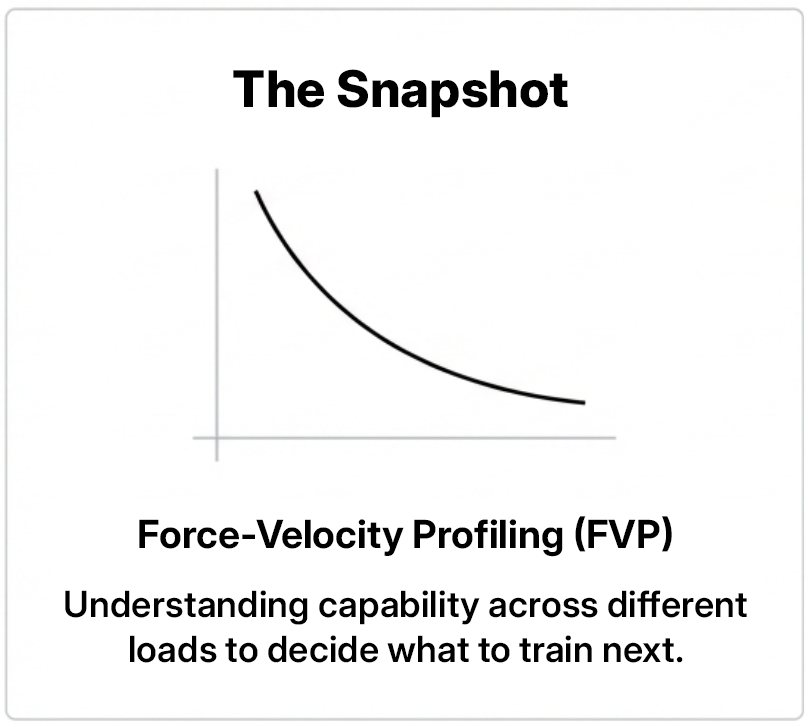
Force–velocity profiling (FVP) helps you understand how an athlete produces force across different movement speeds. We capture performance at a few different loads, then look at how force, velocity, and power relate. In practice, this gives you a clearer picture of current capability and what to prioritize next.
Return-to-sport demands show up at higher speeds and under tighter time constraints. FVP helps you quantify whether the athlete can express force quickly as you progress toward late-phase work.
Most force–velocity research comes from performance settings. Direct evidence in ACLR populations is developing. In clinic, we use FVP to structure decisions within a criteria-based plan, not as a standalone clearance tool.
Key terms you can use with athletes
-
Force: How much effort the athlete can produce against a resistance.
-
Velocity: How fast the athlete can move at a given load.
-
Power: Force expressed quickly. In clinic terms, power helps you connect strength work to sport demands.
-
Rate of force development (RFD): How quickly force rises at the start of a contraction. In rehab, we consider this one contributing factor when preparing athletes for tasks that occur under time constraints, such as acceleration, landing, and change-of-direction.
What FVP helps you see in ACL rehab
FVP supports common clinical decisions by making performance across speeds easier to interpret. It helps you answer questions like:
-
Is the athlete building force capacity as load increases?
-
Does movement speed drop earlier than expected at moderate loads?
-
Do the involved and uninvolved limbs show similar output across speeds?
-
Does the athlete express power in a way that supports late-phase progressions?
These insights help you adjust exercise selection, loading, and progression timing. They also give you clear language to explain why you are holding a phase, advancing it, or changing the dose.
How this connects to velocity-based rehab
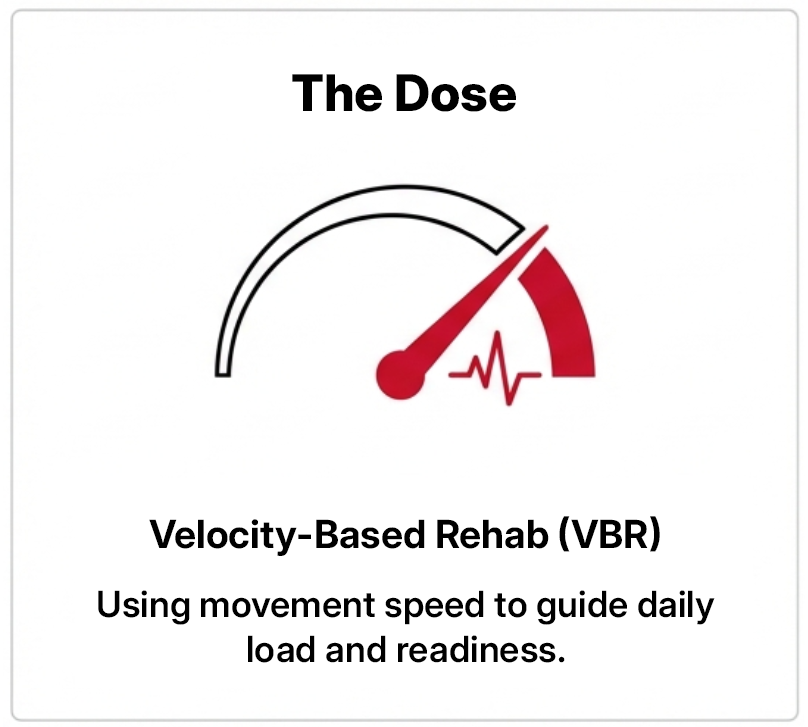
Velocity-based rehab (VBR) uses movement speed to guide loading and day-to-day progression. When you track velocity, you gain an additional intensity signal without maximal testing. That helps when readiness varies across the week, which is common in ACL rehab.
FVP and VBR work well together because they give you two tools you can apply immediately:
-
A repeatable snapshot of current capability (FVP)
-
A way to dose training on the day using performance feedback (VBR)
How FVP helps you make better programming decisions
Force–velocity data becomes useful when it changes what you do next. In ACL rehab, we can use a simple profile to decide where to place emphasis, how to dose a session, and when to progress toward higher-velocity work.
1) Clarify what the athlete needs next: force capacity, velocity, or both
When you test across a few loads, patterns usually fall into one of three buckets:
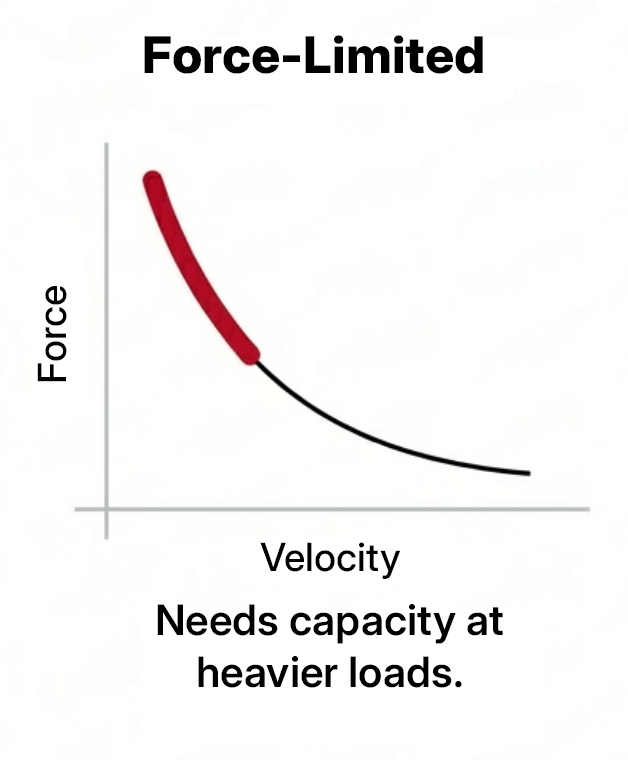
Force-limited presentation
You see lower output as load increases. The athlete needs more force capacity and tolerance at heavier loads.
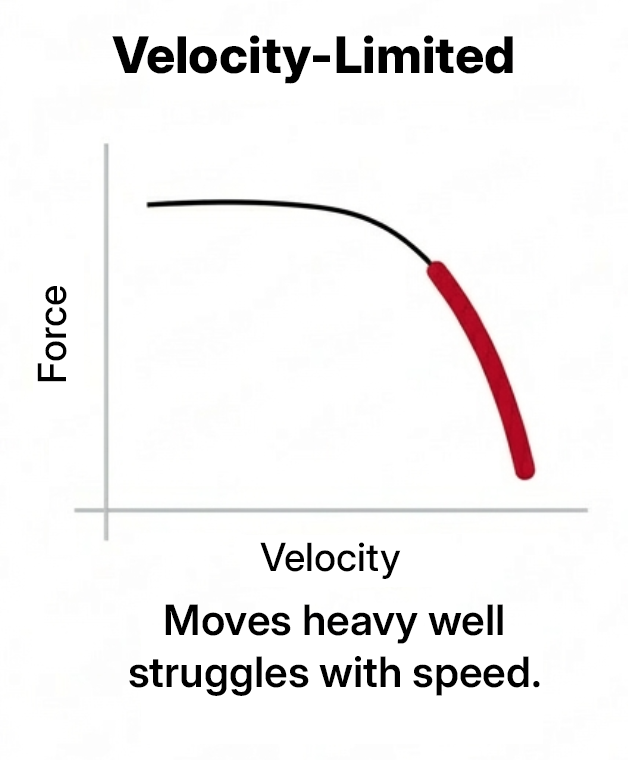
Velocity-limited presentation
The athlete moves well at heavier loads, then struggles to express speed at lighter to moderate loads. The athlete benefits from intent-focused work and controlled exposure to faster outputs.
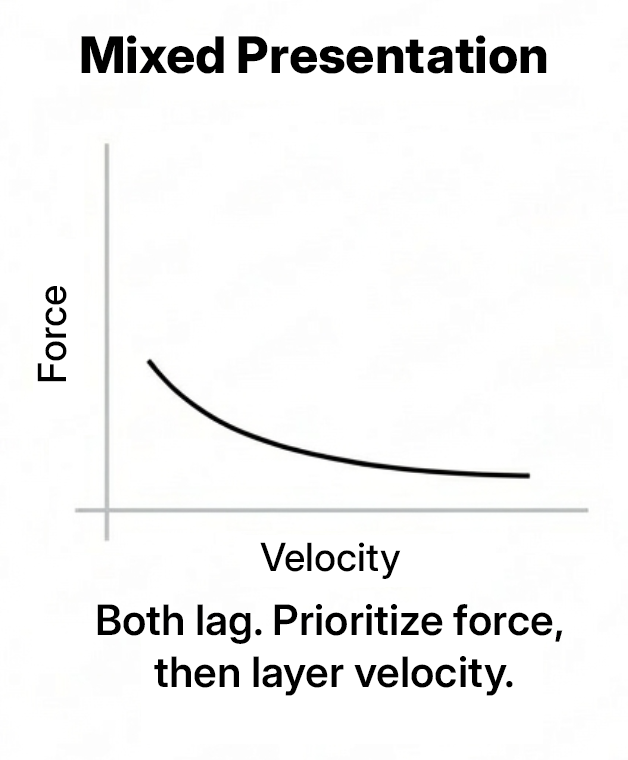
Mixed presentation
Both force and velocity lag across the profile. We usually build force capacity first, then layer in faster intent once the knee tolerates volume and the athlete repeats clean reps.
These buckets help you set a clear priority for the next block instead of adding random “power work” and hoping it transfers.
2) Choose progressions that match the profile
Once you know what is limiting performance, you can match your exercise choices and loading strategies to the goal.
If force is limiting
- Use stable, repeatable patterns that allow progressive loading
- Build weekly exposure to higher-force work using symptom-guided dosing
- Re-test to confirm that heavier-load output improves over time
If velocity is limiting
- Keep load ranges that let you move well and repeat quality reps
- Coach intent and ensure consistent range, setup, and rest
- Add higher-velocity work in small doses and look for stable outputs across sessions
If both are limiting
- Establish a simple strength base you can progress week to week
- Add short velocity exposures after the athlete meets knee response and quality thresholds
- Keep the plan predictable and re-test on a consistent schedule
3) Use velocity to dose the session on the day
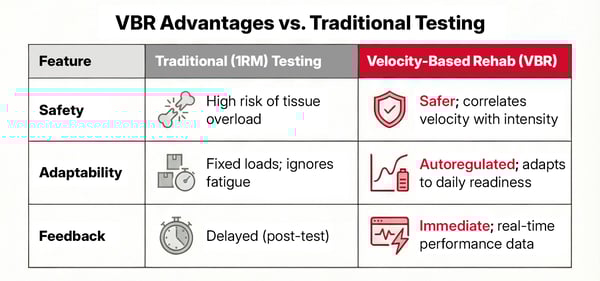 Velocity is a practical “readiness signal” because it responds to fatigue, pain inhibition, and day-to-day variability. You can use it to guide decisions without turning rehab into a lab session.
Here are simple rules clinicians can apply:
- Set a target speed range for the exercise you are using that day
- Adjust load to keep reps in that range while the athlete maintains clean movement
- Watch for meaningful drop-offs in velocity and use that as a cue to reduce load, extend rest, or stop the set
This keeps work specific and repeatable. It also helps you dose intensity while protecting total volume and knee response.
4) Track limb comparison in a way that supports return-to-sport choices
For many clinics, FVP becomes a practical way to compare limb output across speeds. You can evaluate whether the involved limb holds up as speed increases, which matters when you progress plyometrics, deceleration work, and change-of-direction preparation.
We recommend keeping comparisons consistent:
- Same exercise, same setup, same range
- Same rest periods and instructions
- Same testing schedule
When the process stays consistent, you can trust trends and make clearer decisions on progression timing.
5) Put the profile into a simple re-test cadence
FVP works best as a repeatable check-in, not a one-time event. A practical cadence is every 2–4 weeks, timed to the end of a training block. That gives you enough time for adaptation and keeps the results actionable.
If you track one or two key exercises consistently, you can build a useful performance story across the full rehab timeline.
How to implement FVP in a real clinic
Velocity tracking tools can add precision, yet they are optional. Effective ACL rehabilitation does not depend on hardware, and many clinics progress athletes successfully using consistent setups and clear progression criteria.
You do not need a lab to make force–velocity work useful. You need a repeatable setup, a simple protocol, and a plan for how you will use the results. This module gives you implementation options that fit different clinic realities.
Minimal tier: consistent setup and repeatable outputs
This tier works when you want structure and trending, even without dedicated velocity hardware. This approach can support strong clinical decisions when applied consistently. Velocity measurement adds detail, yet it is not required to build strength, restore symmetry, or prepare an athlete for later-phase progressions.
- Choose one lower-body pattern you can repeat (knee-dominant is usually most useful for ACL cases)
- Standardize range of motion, seat position, foot placement, and warm-up
- Use the same rep instructions every time (fast intent with clean control)
- Track outputs you can capture consistently (load used, reps completed, rest time, symptom response)
- Re-test on the same schedule so trends stay meaningful
You will not build a full force–velocity curve here, yet you can still create a reliable performance record that guides progressions.
Standard tier: capture velocity and build a practical profile
This option adds objective speed data and can improve clarity when you want deeper insight into load–velocity relationships.
What you need
A way to measure velocity consistently (encoder, LPT, or validated velocity capture tool).
What you do
- Select one exercise you can reproduce with the same mechanics each session
- Use 3–5 loads that cover light to heavier effort
- Perform 2–3 high-quality reps per load
- Rest long enough to keep outputs honest
- Record mean or peak velocity for each load
You now have enough information to see where output drops, where the athlete expresses power well, and how the profile changes across blocks.
Advanced tier: integrate limb comparison and late-phase prep
This tier fits rehab leaders who want deeper insight as athletes transition into higher-speed demands.
- Compare involved and uninvolved limbs across the same loads and setup
- Add a second exercise when it improves clarity (for example, a hip-dominant pattern alongside a knee-dominant pattern)
- Track velocity consistency under mild fatigue, when appropriate for the phase
- Use results to guide progression toward deceleration and change-of-direction preparation
This tier works best when your team already runs consistent re-testing and uses objective criteria for phase progression.
A clinic-ready FVP session (15-minute protocol)
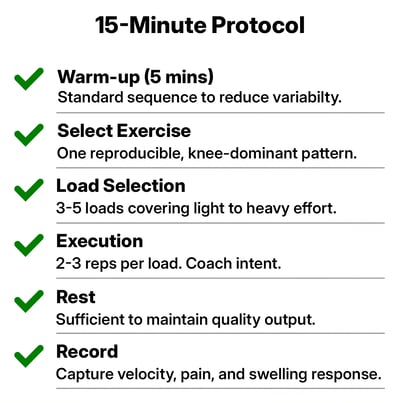 Use this as your default when you want repeatable data you can act on.
- Standard warm-up (5 minutes)
Use the same sequence each time so early-session variability stays low. - Choose one primary test exercise
Pick a pattern you can reproduce. Keep setup and range consistent. - Run 3–5 loads, light to heavier effort
We want enough spread to see how speed changes as load increases. - Perform 2–3 reps per load
Coach intent. Stop a set if form changes or the athlete cannot repeat the same range. - Rest enough to keep reps clean
Consistent rest improves the quality of your comparison across loads. - Record outputs and knee response
Capture velocity metrics when available. Also note pain, swelling response, and movement quality. - Re-test every 2–4 weeks
Tie testing to the end of a training block so you can adjust the next block with confidence.
Standardization rules that protect your data
When clinicians feel that profiling “takes too long,” the issue is usually setup drift. These rules keep the process stable:
- Keep the same equipment setup, seat settings, and range of motion
- Use the same verbal cue every session (“fast intent, clean control”)
- Use the same rest periods across loads
- Record which velocity metric you track and stick with it
- Log knee response the next day when possible
When your process stays consistent, your results become easier to interpret and more useful for progression decisions.
What to document to ensure a repeatable profile
Use these fields as a quick template in your note or testing log. When the team records the same details each time, your trends become easier to trust.
- Date + post-op week (or phase):
- Test exercise + setup: equipment used, seat/bench settings, foot position, range of motion standard
- Loads used: list the 3–5 loads (and any adjustments made on the day)
- Velocity metric captured: mean or peak velocity (note the device/tool if applicable)
- Best rep per load: record the top value and how many reps were performed
- Rest periods: planned rest and any deviations
- Movement quality notes: compensations, depth consistency, pain behaviors, technical limits
- Knee response: pain during, pain after, swelling/effusion later that day or next day (if you track it)
- Clinician decision: what you changed next (load, volume, exercise choice, progression timing)
Tools and Equipment for Velocity-Based ACL Rehab
Access to isokinetic testing varies. Cost, time, and availability often limit how often clinicians can use it in day-to-day practice.
We can still collect objective data that improves decision-making. Force–velocity profiling and velocity-based rehab give you practical ways to measure strength and power across a range of clinic environments.
Practical ways to capture velocity data in clinic
You can build a useful force–velocity picture with tools that measure movement speed and output across a few loads. Common options include linear position transducers, load cells, and portable approaches such as smartphones and wearable sensors.
Whatever tool you use, results improve when you standardize the parts that create noise:
- Movement and setup: keep seat position, range of motion targets, and foot placement consistent
- Instruction: use the same cue each time and coach clean, repeatable reps
- Rest: keep rest periods consistent so fatigue does not drive the result
- Metric: choose one velocity metric and track it the same way each session
When those inputs stay stable, you can compare results across blocks and use trends to guide the next programming decision.
How Keiser’s Pure Resistance Technology™ (PRT) supports velocity work
Keiser’s Pure Resistance Technology™ (PRT) uses compressed air (pneumatics) under digital control rather than iron resistance. The system is designed with very low mass in the resistance pathway, which reduces inertia and momentum during the rep.
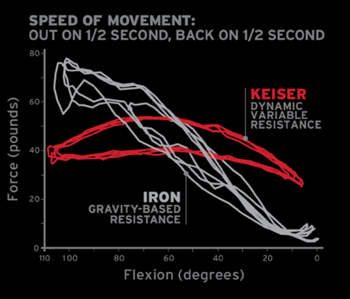 For velocity-based work, that lower-inertia feel supports cleaner intent reps and more consistent rep-to-rep outputs. When your setup stays the same, you can track velocity with greater confidence across rehab blocks.
PRT also provides consistent resistance across different movement speeds, which helps when you train and test across velocity ranges while keeping loading predictable.
In clinic, this supports three practical goals:
-
Progress intent and speed while keeping movement quality stable
-
Reduce rep-to-rep variability that can show up when momentum changes output
-
Re-test the same movement over time with fewer setup variables
How Keiser supports a velocity-based workflow
Keiser’s A400 machines capture mean and peak velocity and mean and peak power so you can track consistency and maximum output over time. The system also tracks range of motion and supports small load adjustments, which helps when you profile across multiple loads and re-test across phases.
We still run the same process, regardless of equipment: standardize the setup, capture a small set of meaningful outputs, decide the next block emphasis, then re-test on schedule. Force–velocity profiling works when you keep it repeatable and let the data drive a clear programming decision.
How to use FVP results to guide programming
Once you have a repeatable profile, the next step is simple: decide what you will train over the next block. We use FVP to set a priority, choose the right exposure, and confirm that the plan is working when you re-test.
Step 1: Sort the profile into a clear training priority
Most profiles point you toward one main emphasis for the next 2–4 weeks.
Force capacity emphasis
You see larger drop-offs as load increases. The athlete benefits from building higher-force output and tolerance at heavier efforts.
Velocity expression emphasis
The athlete maintains output as load rises, yet struggles to express speed at lighter to moderate loads. The athlete benefits from faster intent work that stays clean and repeatable.
Combined emphasis
Force and velocity both lag across loads. We usually build force capacity first, then layer velocity exposure once the knee tolerates volume and the athlete repeats quality reps.
Step 2: Match the emphasis to a practical loading plan
Use these as starting points. Your exercise choice, knee response, and phase criteria still guide the final dose.
If you are building force capacity
- Keep exercise selection stable so the athlete can progress load with confidence
- Use moderate rep ranges that support exposure and tolerance
- Increase weekly loading gradually and track knee response
- Re-test to confirm heavier-load output improves across blocks
Common clinic application: knee-dominant strength work with consistent setup and progressive loading.
If you are building velocity expression
- Choose loads that allow clean speed and repeatable range of motion
- Coach intent and keep rest periods consistent
- Use smaller sets so each rep stays high quality
- Progress speed exposure gradually and confirm outputs stay stable week to week
Common clinic application: lighter to moderate loads moved with clear intent, paired with technique constraints that protect quality.
If you are addressing both
- Establish a predictable strength base across the week
- Add a short velocity exposure session once quality and knee response meet your thresholds
- Keep overall volume controlled so speed work stays consistent
Common clinic application: one heavier session, one intent-focused session, plus accessory work that supports capacity.
Step 3: Use velocity to dose the day
When you track velocity in-session, you can adjust load to keep work targeted and consistent.
A simple clinic rule set
- Pick one velocity metric to track and use it consistently
- Set a target speed range for the day’s exercise
- Adjust load to keep reps in range while the athlete maintains form
- Stop a set when speed drops enough that quality changes
This approach gives you a clear “why” behind adjustments. It also supports better conversations with athletes who feel ready to push harder on low-readiness days.
Step 4: Make limb comparisons meaningful
If you use FVP to compare limbs, consistency matters more than complexity.
- Use the same exercise, setup, range, and instructions
- Keep rest periods consistent across sides
- Compare results across similar effort levels and loads
- Track trends across blocks rather than relying on a single session
Over time, this helps you see whether the involved limb keeps up as you progress toward higher-speed demands.
Step 5: Re-test to confirm the plan is working
We recommend a re-test cadence every 2–4 weeks, aligned with the end of a training block. When outputs improve in the direction you targeted, you have support for your next progression. When they do not, you can adjust the plan with a clear reason.
If you keep one primary test exercise consistent through rehab, you build a useful record that supports progression decisions and return-to-sport discussions.
Example: Clarify what the athlete needs next (three common scenarios)
Use these as quick reference cases. The goal is to connect the profile to a clear next step for the upcoming block.
Common mistakes and quick fixes when using FVP and velocity in ACL rehab
FVP becomes valuable when your process stays consistent and your results change what you do next. Most issues show up in the same places: setup drift, unclear intent, and collecting data without a decision attached. Use the checks below to keep profiling efficient and clinically useful.
Mistake 1: Changing the setup between sessions
Small changes in seat position, range, or foot placement can shift outputs enough to confuse interpretation.
Quick fixes
- Record equipment settings the first time and reuse them every session
- Standardize range of motion with a clear stop point you can repeat
- Use the same warm-up sequence so early reps feel similar week to week
Mistake 2: Mixing “effort reps” with “test reps”
If one session includes grinding reps and another includes crisp reps, the data becomes harder to compare.
Quick fixes
- Coach a consistent instruction: “fast intent, clean control”
- Keep reps per load low (2–3) and stop when form changes
- Rest consistently so fatigue does not become the main driver of velocity drop
Mistake 3: Using too many loads and turning it into a long test
FVP works well with a small number of loads when you keep the process stable.
Quick fixes
- Use 3–5 loads that span light to heavier effort
- Keep your primary test exercise the same across blocks
- Set a time cap for the test and stick to it
Mistake 4: Tracking a number without linking it to a plan
Velocity is only helpful when it guides loading, exercise choice, or progression timing.
Quick fixes
- Write one decision line after each test: “Next block emphasis = force capacity” or “Next block emphasis = velocity expression”
- Tie the decision to a change you can point to (load range, set structure, exercise selection)
- Re-test at the end of the block to confirm the change moved the profile in the direction you expected
Mistake 5: Treating day-to-day changes as a true trend
Velocity responds to sleep, fatigue, pain inhibition, and timing within the week. A single reading can be noisy.
Quick fixes
- Compare results at similar points in the week and similar training states
- Use trends across 2–4 weeks to guide bigger programming shifts
- Keep one primary metric consistent (mean or peak velocity) so you reduce variability
Mistake 6: Ignoring knee response when you increase velocity exposure
Some athletes tolerate intent-focused work well, and others need tighter dosing. Knee response still sets the guardrails.
Quick fixes
- Increase speed exposure in small steps and keep total volume controlled
- Document symptoms during the session and later the same day when possible
- Use the next-day knee response to guide the following session’s dose
Mistake 7: Comparing limbs without controlling the test conditions
Limb comparison only helps when you standardize how you collect it.
Quick fixes
- Use the same setup, range, and rest periods for both sides
- Keep instructions identical and record which metric you use
- Compare like-for-like loads and effort levels across sessions
A simple troubleshooting checklist for the team
Before you interpret a profile, confirm:
- Setup and range match your baseline session
- Warm-up and rest periods stayed consistent
- Reps stayed clean and repeatable
- You captured the same metric you track every time
- You wrote a clear decision for the next block
Where FVP and velocity fit inside a criteria-based ACL rehab plan
Force–velocity profiling and velocity tracking work best when they support the same goal as the rest of your rehab process: clear progression decisions. We use them to guide loading, confirm adaptation across blocks, and support readiness discussions as athletes move toward higher-speed demands.
Use FVP when you need a clear training priority for the next block
FVP is most helpful at transition points, when you want objective support for what to emphasize next.
You can use it to:
- Choose whether the next block focuses on force capacity, velocity expression, or a combined emphasis
- Confirm that strength work is carrying over to faster outputs as you progress
- Track whether the involved limb maintains output as demands increase
- Support return-to-sport conversations with objective trends, not a single snapshot
A practical cadence is every 2–4 weeks, aligned with the end of a training block.
Use velocity tracking to dose sessions and protect quality
Daily velocity data helps you manage variability across the week. When you track a consistent metric in a consistent exercise, you can adjust load to keep reps inside the target zone for that day.
We typically use velocity tracking to:
- Guide load selection without maximal testing
- Protect rep quality when fatigue builds
- Decide when to stop a set before technique changes
- Keep intent-focused work repeatable across sessions
Keep the approach phase-aware
You can apply these tools across rehab when you match the dose to the athlete’s current tolerance and the goals of the phase.
Earlier strengthening phases
We use a consistent setup and stable patterns to build a repeatable baseline. Velocity helps you coach intent while you protect range, control, and knee response.
Mid rehab progressions
We use FVP to confirm that higher-force work is improving output across loads. We also start paying closer attention to how the athlete expresses speed at lighter to moderate loads.
Later-phase preparation
We use trends to support decisions as you expand power work, deceleration exposure, and change-of-direction preparation. Limb comparison across speeds becomes more meaningful here because sport demands show up quickly.
Connect the data to the decision
Whatever tier you use, the process stays the same:
- Standardize the test
- Capture a small set of useful outputs
- Choose a clear emphasis for the next block
- Re-test on schedule and confirm direction of change
When you follow that loop, FVP and velocity tracking become simple tools that strengthen your criteria-based plan.
Download the complete phase-based ACL rehab framework
This page gives you a practical way to implement force–velocity profiling and velocity-based rehab in a typical clinic. The downloadable guide shows how Manny Patel builds these principles into a phase-based plan with clear progression criteria and return-to-sport checkpoints.
In the ACL Rehab Guide, you’ll get:
- A phase-by-phase progression you can follow and adapt in clinic
- Readiness criteria and testing checkpoints that support progression decisions
- Practical guidance for building strength, power, and workload tolerance across rehab
- A clinician-friendly checklist you can use for documentation and re-testing
GET THE ACL REHAB GUIDE
Includes a phase-based progression, criteria checkpoints, and a practical testing checklist for clinic use.
Learn More
Quick recap
- Force–velocity profiling helps you understand output across loads and speeds
- Velocity tracking helps you dose sessions using repeatable performance feedback
- A consistent setup and a simple re-test cadence make the data clinically useful
- The goal is a clear decision for the next block, supported by objective trends
FAQs: Force–velocity profiling and velocity-based rehab in ACL care
What is force–velocity profiling in rehab?
Force–velocity profiling (FVP) describes how an athlete produces output across different loads and movement speeds. In clinic, we use it to see whether the athlete benefits most from building force capacity, improving velocity expression, or progressing both qualities in a structured way.
Do we need isokinetic testing to use this approach?
You can apply FVP and velocity-based rehab without isokinetic equipment. Many clinics use a repeatable exercise setup and a simple velocity capture method to track trends across blocks. The value comes from consistency in setup, re-test cadence, and clear programming decisions based on the results.
What velocity metric should we track: mean or peak?
Both can be useful. We recommend choosing one metric your team can capture reliably and using it consistently. Mean velocity often reflects the overall rep, while peak velocity captures the fastest point. Consistent measurement matters more than the specific choice when you are tracking change over time.
How often should we re-test force–velocity measures after ACL reconstruction?
A practical cadence is every 2–4 weeks, aligned with the end of a training block. This timing gives the athlete enough exposure to adapt and gives you clear information to guide the next block.
How do we use velocity data to adjust load in a session?
We use velocity as a session guide. You set a target speed range for the exercise, then adjust load to keep reps within that range while the athlete maintains clean movement. When velocity drops enough that technique or range changes, we treat that as a cue to reduce load, extend rest, or end the set.
When should we start intent-focused or higher-velocity work after ACL?
We start when the athlete meets the phase goals that support quality output: stable symptoms, repeatable range, and consistent movement control. From there, we increase velocity exposure in small steps and track knee response across the day and the next day. This keeps progression aligned with tolerance and the demands of later-phase rehab.
Is velocity tracking equipment required to use this framework?
No. Velocity tracking can add structure and objectivity, yet it is optional. The framework works when you standardize setup, apply consistent progression criteria, and base decisions on knee response and performance trends.
About the Author
 Manoj “Manny” Patel is a Consultant Chartered Physiotherapist for Keiser UK & Ireland and a Chartered Physiotherapist (MSc, BSc (Hons), DiP, MSCP, SRP). He has over two decades of experience across physiotherapy, health, and fitness, with clinical and performance experience spanning the NHS, military settings, sport, and private practice.
This article was adapted from Manny’s ACL Rehab practitioner guide.
GET THE ACL REHAB GUIDE
Includes a phase-based progression, criteria checkpoints, and a practical testing checklist for clinic use.
Learn More

© 2026 Keiser Corporation | 2470 S. Cherry Ave | Fresno CA 93706