Neurocognitive and Motor Control Factors That Shape Return to Sport After ACL
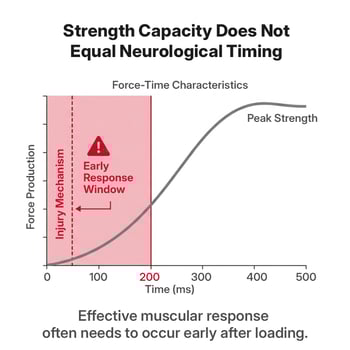 You can rebuild strength and still miss the timing, coordination, and decision-making demands that show up in cutting, landing, and deceleration. We’ll show you how to program the neurocognitive layer with clear progressions you can apply in clinic.
After ACL reconstruction, many athletes regain “normal” strength levels. Return-to-sport readiness is influenced in part by how quickly the nervous system organizes force, stabilizes the knee, and adapts to fast decisions under pressure.
Protective muscle activity typically needs to happen quickly after joint loading. When timing slips, the knee may absorb more of the demand during high-speed tasks.
Neurocognitive changes can persist after ACL injury in some athletes. Many athletes show measurable deficits in reaction time and processing speed, which influences movement control when sport gets fast.
Designed for clinicians who guide athletes through late-phase ACL rehab and return-to-sport decisions, including Physiotherapists, DPT/PTs, Athletic Trainers, Rehab Managers, and Lead Clinicians.
In this page you'll learn how to:
-
Program motor control that holds up during deceleration, landing, and change of direction
-
Layer cognitive challenge without losing movement quality
-
Use a simple progression ladder: stable control → reactive control → sport-relevant decision speed
-
Spot common late-phase pitfalls that slow progress and increase risk
-
Tie neurocognitive work to objective readiness signals you can track over time
What the downloadable guide adds:
-
Phase-by-phase strength, power, and velocity benchmarks
-
Quad symmetry and unilateral testing criteria
-
Clear progression thresholds for load, speed, and cognitive complexity
-
Re-testing timelines to guide decision-making
- A structured return-to-sport readiness checklist you can document and defend

GET THE ACL REHAB GUIDE
Includes a phase-based progression, criteria checkpoints, and a practical testing checklist for clinic use.
Learn More
What Changes After ACL: Neurocognitive and Motor Control Factors You Need to Train
After ACL injury and reconstruction, the knee keeps sending different information to the brain. Changes in mechanoreceptor input can reduce corticospinal excitability and influence how well you recruit the quadriceps. Over time, some athletes show persistent changes in neural activity and motor pathway efficiency that affect coordination and control.
You’ll see these changes most clearly when the athlete needs speed, timing, and precision.
Key neurophysiological changes (what to watch for)
1) Slower protective timing during joint loading
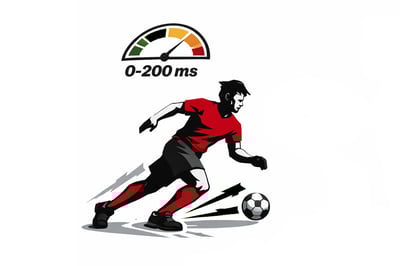
Sport actions happen fast. Effective muscular response often needs to occur very early after loading, and protective activity for the ACL is thought to depend on rapid force production in that initial phase. When that response is delayed, the knee may take on more of the stress during landing, cutting, and deceleration.
2) Reduced rate of force development (RFD)
Athletes can regain strength while still producing force too slowly to meet sport demands. After ACL reconstruction, RFD asymmetry can persist for extended periods and is considered a contributing factor to performance limitations and potential re-injury risk. You should track how quickly the athlete produces force, not only how much force they can produce.
3) Higher cognitive load during movement
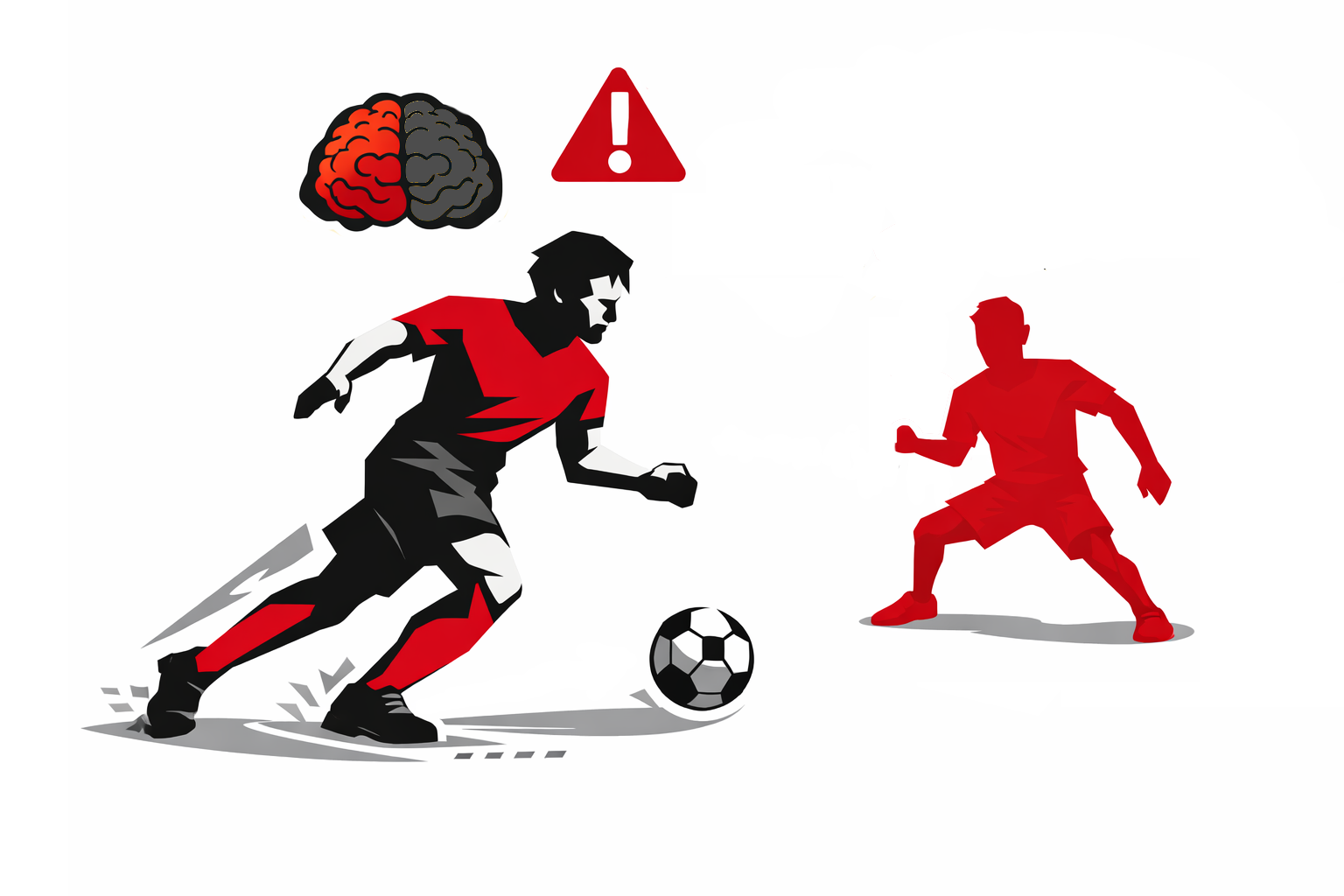
Some athletes need more brain “work” to complete tasks that used to be automatic. Some research suggests changes in neural activity patterns (often described as maladaptive neuroplasticity) and increased activation during simple motor tasks. This may raise cognitive load and reduce performance during complex situations.
4) Measurable neurocognitive deficits
Reaction time, processing speed, and aspects of memory can be reduced after ACL injury. These deficits can matter because sport requires rapid decisions and rapid movement corrections.
What this means in clinic (movement-level signs)
You’ll often see one or more of the following:
-
Delayed stabilization after landing or braking
-
Reduced knee flexion strategy during deceleration
-
Inconsistent single-leg control as pace increases
-
Slower “read and react” responses during cutting tasks
-
Breakdowns under fatigue or time pressure
These signs help you decide when to add targeted neurocognitive progressions.




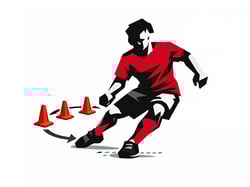
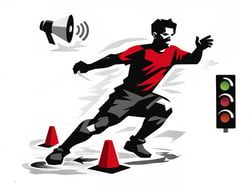
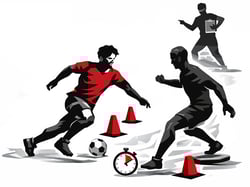
Integrate Cognitive Load With Clear Dose and Complexity Control
Once you’ve defined the progression level, your next job is to control dose and complexity inside that level. Neurocognitive training becomes effective when you manage variables precisely. You should know what you are adding, why you are adding it, and what performance marker must stay stable.
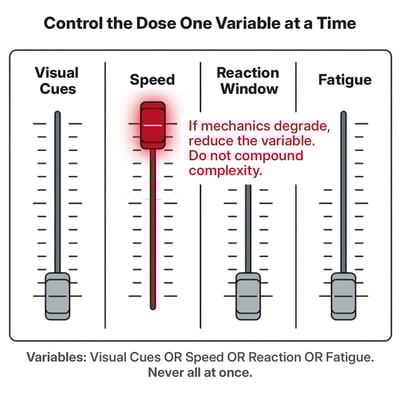 Control one variable at a time
Within any stage of progression, introduce a single change per session block.
Examples:
- Add one visual cue
- Increase approach speed slightly
- Shorten reaction window
- Introduce a fatigue constraint
One variable allows you to identify what changes performance. Multiple variables blur your feedback.
Protect movement quality under increasing demand
As cognitive load rises, you should monitor:
- Knee alignment during deceleration
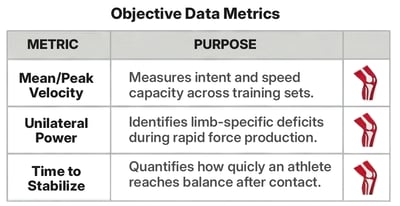
- Time to stabilize after contact
- Consistency of approach speed
- Limb symmetry under velocity
If mechanics degrade, reduce the variable you just added. Maintain the base task.
Manage volume carefully
Reactive drills increase neural and metabolic demand quickly. Use shorter sets and clear rest periods to preserve output quality. When performance drift appears late in a set, stop the set. Dose determines learning.
Use constraints to standardize complexity
Set clear parameters so performance stays comparable across sessions:
- Fixed landing zones
- Defined cutting angles
- Prescribed approach distances
- Consistent rest intervals
Constraints allow you to progress complexity without losing control of the task.
Monitor knee response as a progression filter
Cognitive layering should not change knee tolerance unpredictably.
Track:
- Pain during session
- Effusion or stiffness later that day
- Next-day response
Adjust dose based on response trends, not isolated sessions.
What to document each session
Keep documentation simple and repeatable:
- Variable introduced
- Movement quality under that variable
- Velocity or power consistency if measured
- Knee response within 24 hours
This record supports clear progression decisions.
Quick takeaway
Inside each progression stage, control one variable at a time. Protect mechanics. Manage volume. Standardize constraints. Let performance consistency and knee response guide complexity.
Use Keiser A400 Data to Measure Neurocognitive Readiness Before You Add Sport Complexity
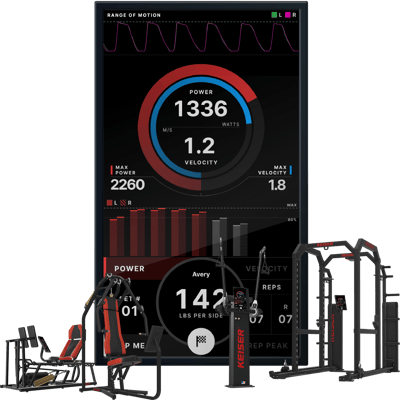
Neurocognitive progression works best when you anchor it to objective output. Before you increase reactive cutting, chaotic landing tasks, and fatigue-based decisions, you should confirm that the athlete expresses force quickly, consistently, and symmetrically — key physical outputs that support neurocognitive readiness. Keiser's A400 resistance machines support this process by capturing performance data every rep and set.
Why objective measurement matters in this phase
Late-phase ACL rehab asks for fast control. You need confidence that the athlete can:
-
Express force quickly during braking and propulsion
-
Maintain limb symmetry as speed increases
-
Stabilize the knee with repeatable mechanics under velocity demands
When you can measure these outputs, you progress neurocognitive work with clarity.
These measures do not directly capture neurocognitive processes, but they provide practical insight into how force is expressed under time constraints.
 What the A400 helps you measure (clinically useful outputs)
Keiser A400 machines provide metrics that support return-to-sport decision-making:
-
Mean and peak velocity: Track intent, speed capacity, and consistency across sets
-
Mean and peak power: Quantify explosive output and monitor progress across blocks
-
Unilateral performance measures: Compare involved and uninvolved limbs under the same task
-
Range of motion display: Standardize movement depth and improve session-to-session repeatability
This data gives you a direct view of how the athlete expresses force under controlled conditions. While this does not directly measure neurocognitive function, it gives you objective markers that help guide when to safely increase cognitive and reactive demands. These outputs do not replace broader clinical testing, yet they give you a clearer view of one important part of late-phase readiness.
How we use A400 data to guide neurocognitive progression
Use the A400 as a checkpoint system that supports progression decisions.
-
Establish a stable baseline
Pick one or two key patterns you’ll repeat, such as leg press and knee extension. Standardize range, setup, rest, and cueing so your data stays comparable.
-
Build rapid force expression
Coach intent. Track mean and peak velocity across sets. Use power outputs to confirm the athlete produces fast, meaningful work without compensations, which supports progression toward higher-speed and reactive tasks.
-
Confirm limb symmetry under speed
Run unilateral sets and compare outputs. Track whether symmetry holds as you increase velocity demands. Use this to guide loading choices and exercise selection.
-
Progress complexity with objective guardrails
When velocity and power remain consistent, you can add reaction cues and decision tasks with more confidence. When outputs drop, you adjust dose, rest, or complexity.
Where this fits in your progression ladder
A400 data supports each stage:
-
Stable control: Confirm repeatable velocity and power with clean mechanics
-
Reactive control: Maintain outputs while you add simple reaction cues
-
Sport-integrated decision speed: Monitor drift as fatigue and context demands rise
 This approach helps you connect what you train to what the athlete can repeat under speed.
Quick takeaway
If early force expression matters for joint control, you should measure it objectively. Use objective velocity, power, and unilateral outputs to confirm readiness before you layer higher-speed decisions and sport complexity.
Avoid These Common Mistakes When Programming Neurocognitive Return-to-Sport Progressions
Neurocognitive training adds value when you progress it with structure and measurable intent. Most setbacks occur when complexity increases faster than the athlete’s capacity to control force and timing. Use the checks below to keep progression clear and repeatable.
1) Advancing complexity before force expression stabilizes
You should confirm rapid, repeatable force production before layering reaction and decision demands. When velocity and power fluctuate across sessions, reactive drills amplify those inconsistencies.
What to do instead
-
Confirm symmetrical limb output
-
Track velocity trends across training blocks
-
Progress approach speed gradually
-
Add cognitive variables only after performance stabilizes
Clear objective markers improve your timing for progression.
2) Adding too many variables at once
When you introduce visual cues, directional changes, fatigue, and competitive pressure simultaneously, it becomes difficult to identify what drives breakdowns.
What to do instead
-
Introduce one new variable per progression step
-
Keep the base movement consistent
-
Monitor knee response within and after the session
-
Reassess performance before advancing further
Structured layering improves learning and motor consolidation.
3) Ignoring performance drift under fatigue
Neurocognitive breakdown often appears late in sessions. Slower decision speed, reduced knee flexion strategy, and delayed stabilization can show up when reserve declines.
What to do instead
-
Observe time to stabilize during later reps
-
Monitor consistency of velocity output
-
Reduce volume when mechanics degrade
-
Build fatigue exposure gradually
Fatigue response gives you valuable information about readiness.
4) Overlooking limb-specific deficits during velocity work
Limb symmetry in static strength testing does not guarantee symmetry during rapid force production. As speed increases, asymmetries can reappear.
What to do instead
-
Track unilateral velocity and power trends
-
Compare outputs across similar loads
-
Re-test consistently under standardized conditions
-
Adjust loading when asymmetry widens
Objective comparison strengthens your return-to-sport decisions.
5) Treating novelty as progression
New drills feel engaging, but progression depends on measurable improvement. When drills change every week, trend tracking becomes unreliable.
What to do instead
-
Keep key drills consistent across phases
-
Standardize setup, range, and cueing
-
Document performance changes across blocks
-
Use complexity as a tool, not as variety
Consistency supports clinical clarity.
6) Disconnecting neurocognitive work from phase goals
Each stage of rehab has a primary objective. Early late-phase work emphasizes force capacity and velocity expression. Later stages emphasize decision speed and contextual movement control.
What to do instead
-
Align neurocognitive drills with phase priorities
-
Confirm strength and velocity benchmarks before chaos exposure
-
Tie progression decisions to measurable outputs
-
Maintain a clear re-test cadence
When neurocognitive training aligns with objective criteria, progression becomes more predictable and defensible.
Quick takeaway
Neurocognitive training is intended to improve how strength expresses itself when you build it on stable force production, progress one variable at a time, and anchor decisions to measurable performance trends.
Integrate Neurocognitive Training Into a Criteria-Based Return-to-Sport Framework
Neurocognitive training works best when it sits inside a structured, criteria-based progression. We use objective testing as the foundation for every phase. Then we layer motor control, velocity exposure, and decision speed on top of measurable performance trends. Return-to-sport decisions become clearer when each progression step links to data you can document and repeat.
We treat neurocognitive capacity as one contributing factor within return-to-sport readiness, alongside strength, symmetry, movement quality, workload tolerance, and knee response.
Start with objective benchmarks
Every phase of ACL rehab should include measurable markers. These markers guide when you:
- Increase load
- Increase velocity
- Add reactive elements
- Progress to sport-integrated tasks
You should confirm:
- Adequate force capacity
- Stable limb symmetry
- Consistent velocity output
- Predictable knee response across sessions
Objective testing creates a shared standard across clinicians and across time.
Follow a repeatable progression loop
Use a simple loop to keep decisions consistent:
-
Standardize the task
Choose key patterns you will repeat. Keep setup, range of motion, rest, and cueing consistent.
-
Capture performance data
Track strength, velocity, power, and limb comparisons. Record knee response and quality markers.
-
Choose the emphasis for the next block
If force lags, build capacity.
If velocity lags, prioritize intent and speed expression.
If reactive control drops under cognitive load, adjust exposure and repeat the layer.
-
Re-test on schedule
Reassess every 2–4 weeks or at the end of a training block. Confirm that outputs trend in the intended direction before advancing complexity.
This loop keeps progression grounded in measurable change rather than subjective readiness.
Layer neurocognitive work onto measurable progression
Neurocognitive training is part of the same system.
In earlier strengthening phases, you focus on:
-
Building force capacity
-
Restoring rapid force expression
-
Establishing consistent mechanics
As outputs stabilize, you add:
-
Reactive motor control
-
Decision-making under moderate speed
-
Controlled fatigue exposure
In later phases, you integrate:
-
Sport-relevant decision speed
-
Variable approach angles
-
Higher-context movement sequences
Each layer builds on measurable performance from the previous phase.
Align cognitive load with phase goals
Match complexity to the athlete’s current tolerance.
-
Early late-phase work emphasizes velocity stability and symmetry.
-
Mid-phase progression adds structured reaction cues.
-
Advanced phases integrate sport context and decision speed.
Keep cognitive load proportional to force capacity and knee response. When objective markers hold steady, progression becomes predictable and defensible.
Strengthen Return-to-Sport Decisions With Measurable Criteria
A criteria-based plan gives you clarity when discussing readiness with athletes, coaches, and stakeholders.
You can explain:
-
What has improved
-
What still requires development
-
Why you are progressing or holding a phase
-
How performance trends support the decision
When neurocognitive progression follows measurable benchmarks, return-to-sport decisions become documented and defensible.
You are no longer relying on time since surgery.
You are progressing based on force expression, velocity stability, limb symmetry, and movement consistency under cognitive load.
Pulling It Together
Neurocognitive readiness helps shape how strength expresses itself in sport.
When you:
-
Standardize tasks
-
Capture objective outputs
-
Progress one variable at a time
-
Re-test on schedule
You create a progression model that scales from controlled deceleration to sport-integrated decision speed.
That structure protects the athlete and supports the clinician.
This page outlines the neurocognitive layer of return-to-sport preparation.
The full ACL Rehab Guide integrates:
-
Phase-by-phase progression
-
Clear readiness criteria
-
Strength, power, and velocity checkpoints
-
Practical re-testing timelines
-
Return-to-sport decision support
If you want the complete framework that connects early-phase priorities, force–velocity profiling, quad symmetry, and neurocognitive progression into one criteria-based roadmap, download the clinician guide below.
GET THE ACL REHAB GUIDE
This article covers the key principles. The downloadable guide includes a phase-by-phase progression, practical testing considerations, and return-to-sport readiness checkpoints you can apply in clinic.
Learn More
FAQs
1. What is neurocognitive training in ACL rehab?
Neurocognitive training in ACL rehab targets the brain–body connection that supports timing, coordination, and decision-making during movement. It addresses one part of return-to-sport readiness that sits alongside strength, capacity, and movement quality. After ACL injury, athletes can show changes in reaction time, processing speed, and motor planning. In clinic, this means training:
- Rapid force expression
- Deceleration control
- Reactive direction changes
- Decision-making under speed
We layer cognitive demands onto measurable strength and velocity benchmarks so progression remains structured and phase-aware.
2. When should reactive drills begin after ACL reconstruction?
Reactive drills should begin once the athlete demonstrates:
- Stable deceleration mechanics
- Adequate force capacity
- Consistent velocity output
- Predictable knee response across sessions
You introduce simple reaction cues first, such as single-direction changes or visual prompts. Progress complexity gradually as performance remains stable.Reactive work becomes more sport-integrated as the athlete maintains quality under increasing speed and cognitive load.
3. Why is rate of force development important after ACL surgery?
Rate of force development (RFD) reflects how quickly an athlete can produce force after joint loading. Sport actions occur within tight time windows, and protective muscle activity typically needs to activate rapidly to support knee stability. If RFD remains limited, the athlete may struggle during cutting, landing, and deceleration tasks even when peak strength appears sufficient. Tracking velocity and power trends helps you monitor improvements in rapid force expression across rehab phases.
4. Does dual-task or cognitive training reduce ACL re-injury risk?
Neurocognitive training addresses deficits in reaction time, motor planning, and processing speed that can persist after ACL injury. These factors are thought to influence movement consistency under pressure. While no single drill eliminates re-injury risk, structured cognitive layering improves how strength expresses itself in sport environments. When combined with objective force and velocity benchmarks, it supports safer progression decisions within a broader criteria-based plan.
5. How do you progress neurocognitive training safely?
Follow a structured progression:
- Build stable force capacity and rapid force expression.
- Add simple reaction cues while preserving mechanics.
- Introduce sport-relevant decision speed once outputs stabilize.
- Re-test performance trends before advancing complexity.
Keep tasks standardized, monitor knee response, and progress one variable at a time.
6. Should cognitive load be added before symmetry is achieved?
You should prioritize measurable limb symmetry and stable velocity output before increasing cognitive complexity.If asymmetry widens as speed increases, adjust load and exposure first. Once unilateral outputs remain consistent, you can safely layer decision-making and reactive elements.Objective markers guide the timing of progression.
About the Author
 Manoj “Manny” Patel is a Consultant Chartered Physiotherapist for Keiser UK & Ireland and a Chartered Physiotherapist (MSc, BSc (Hons), DiP, MSCP, SRP). He has over two decades of experience across physiotherapy, health, and fitness, with clinical and performance experience spanning the NHS, military settings, sport, and private practice.
This article was adapted from Manny’s ACL Rehab practitioner guide.

© 2026 Keiser Corporation | 2470 S. Cherry Ave | Fresno CA 93706