KEISER DEADLIFT
REHAB AND CLINICAL APPLICATIONS
Reintroducing the Hinge Pattern with More Control and Less Risk
The deadlift pattern shows up in daily life: lifting bags, getting up from the ground, landing from a jump, bracing through contact, and moving through work tasks. When a patient is ready to reintroduce hinge mechanics, the way you load the movement matters.
Keiser’s low-inertia system gives clinicians a safer and more controlled way to rebuild hinge strength — especially in mid-to-late rehab, return-to-sport phases, or when working with patients who must eventually lift again in their sport or job.
Why Clinicians Use Low-Inertia Loading in the Hinge
Keiser’s Pure Resistance Technology removes unnecessary mass and reduces momentum. This gives clinicians precise control over the forces the patient experiences—especially in the most vulnerable part of the lift.
Smooth, controlled start
Patients aren’t hit with a sudden surge of force off the floor. They can set their posture, engage their trunk, and move through the first inches of the hinge with confidence.
Graded exposure with micro-loading
Resistance adjusts in tiny increments — ideal for restoring tolerance to load and progressing patients gradually without provoking symptoms.
More engagement through the top range
Momentum doesn’t take over as the patient rises. This encourages stronger posterior-chain activation and reinforces healthy patterns through the entire movement.
Less joint stress, fewer surprises
Zero shock loading protects irritated joints, connective tissue, and healing structures.
Where the Deadlift Fits in Rehab
The Keiser Deadlift isn’t an early-phase tool. It’s most effective when:
1. Patients are ready to retrain the hinge pattern
Useful for ACL, hamstring, hip, and low-back cases that need controlled reintroduction of hip-dominant strength (when clinically appropriate).
2. They need exposure to lifting before returning to sport or work
Occupational demands and field sports often require loaded hinges. Low inertia helps bridge the gap safely.
3. Patients benefit from speed or tempo work
Fast eccentrics, controlled drops, and light-speed hinges can be introduced without the risks that come with moving mass.
4. You want objective data during progression
With the A400 display, clinicians can view ROM, velocity, and power changes rep by rep — reinforcing measurable progress and patient confidence.
Movement Variations That Support Rehab Progression
These movements help clinicians progress hinge capacity without exposing patients to unsafe loads or bar path deviations.
Foundational Strength Movements
- RDL
- Stagger-stance RDL
- Suitcase hinge
- Straight-leg calf work
Dynamic Progressions
- Fast eccentrics (for braking strength)
- Drop-catch hinges (with appropriate load)
- Low-load pogo patterns (later-stage tendon or return-to-play work)
Each movement stays centered and stable because resistance doesn’t drift, swing, or pull forward.
A300 vs. A400 for Clinical Use
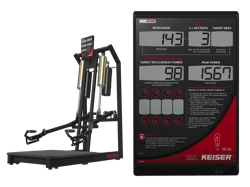
A300 Deadlift
A simple, intuitive display that tracks peak power — ideal for clinics focused on quick setup, general strength, or basic hinge reintroduction.
.png?width=250&height=188&name=A400-Deadlift-Display%20(1).png "A400-Deadlift-Display (1)")
A400 Deadlift
Keiser’s original low-inertia design with power metrics.
- Track velocity and ROM
- Detect movement changes over time
- Set performance thresholds
- Support return-to-sport decisions with measurable output
When the Keiser Deadlift Isn’t the Right Tool
- Keeping patient safety and scope in mind:
- Not appropriate for early-phase rehab (too complex; simpler tools are better)
- Not suited for patients with poor hinge tolerance or acute low-back pain
- Not intended for frail or unstable older adults who struggle with loaded hinge positions
This machine shines when a patient is ready to lift — but needs a controlled path to get there.
Help Patients Lift With Confidence Again
Whether rebuilding strength after injury, restoring functional hinge capacity, or preparing a patient for sport or work demands, the Keiser Deadlift offers a safer, smoother reintroduction to a movement pattern most patients eventually need.
See How Keiser Supports Better Movement and Stronger Recoveries
Discover why clinicians rely on low-inertia resistance for smoother starts and safer progression.
Explore Medical Applications
TRY OUR EQUIPMENT. WE'LL BRING IT TO YOU.
Our mobile showroom will bring the equipment to you.
Learn More