Open vs Closed Chain After ACLR: What the Evidence Supports (and How Clinicians Apply It)
In ACL rehabilitation, the “open chain vs closed chain” conversation usually shows up when you want stronger quadriceps work while you manage early tissue sensitivity and anterior knee symptoms. We can make this debate clinically useful by pairing the evidence with simple progression rules you can apply across phases.
Designed for clinicians managing ACL cases: Physiotherapists, DPT/PTs, Athletic Trainers, Rehab Managers, Lead Clinicians, and Rehab Directors.
What you’ll get on this page:
-
A plain-language summary of what the research supports for OKC and CKC after ACLR
-
Practical progression rules based on ROM, load, timing, and knee response
-
A phase snapshot that helps you choose exercises without guessing
-
Exercise family progressions you can scale across equipment availability
-
Clinician-ready language you can use to explain the “why” to athletes
What the downloadable guide adds:
The guide expands this topic into a full phase-based framework with criteria checkpoints, progression logic, and a clinician-friendly testing checklist you can apply in clinic.

GET THE ACL REHAB GUIDE
Includes a phase-based progression, criteria checkpoints, and a practical testing checklist for clinic use.
Learn More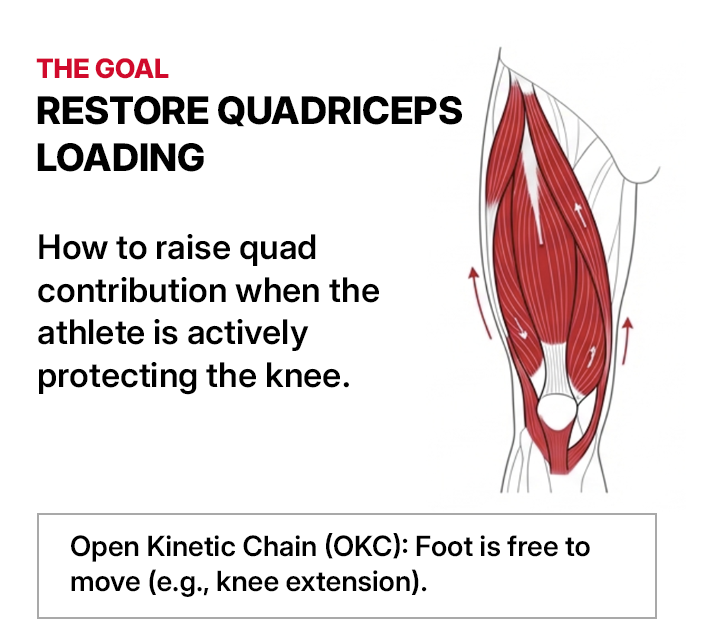
What the evidence supports
There are two key bodies of evidence clinicians can lean on when they build exercise progressions post-ACLR:
-
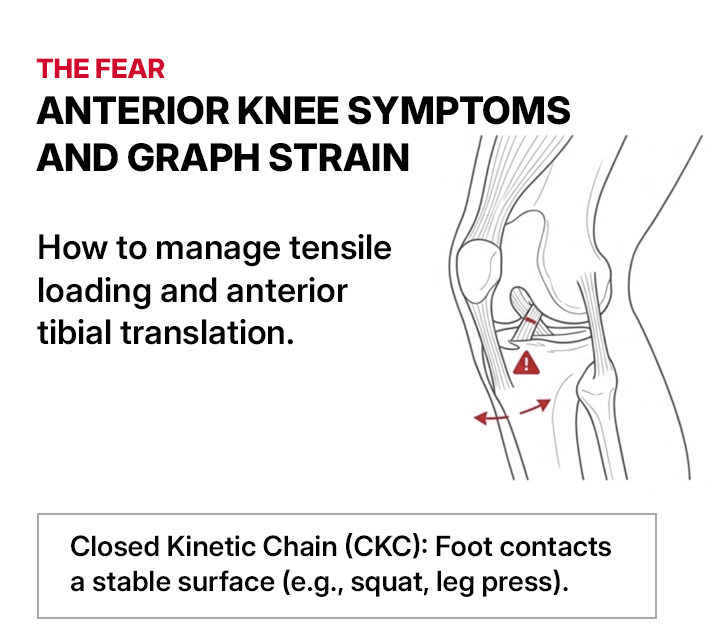
Systematic review and meta-analysis (Perriman et al., 2018): Across randomized trials, OKC and CKC approaches showed similar findings for anterior tibial laxity, strength, and function across follow-up time points.
-
Aspetar clinical practice guideline (Kotsifaki et al., 2023): Studies comparing OKC and CKC reported no meaningful differences in laxity, subjective function, ROM, atrophy, or functional activities. Some data associate OKC work with higher rates of anterior knee pain in certain patients, though symptoms are typically influenced by load, total volume, range selection, and the athlete’s patellofemoral tolerance, rather than OKC exercises themselves.
Clinicians often favor CKC quadriceps work early on because compressive forces and hamstring co-contraction can reduce anterior tibial displacement during isolated quadriceps contractions. However, graft loading is primarily shaped by joint angle, load magnitude, and dosing strategy, not simply whether an exercise is CKC or OKC. Early rehab still requires caution because the graft and the graft-bone interface remain sensitive in the first weeks post-op.
Evidence takeaway you can use in documentation
Both OKC and CKC exercises support quadriceps recovery after ACLR. Your clinical outcomes depend on how you select range, load, and volume, how you time exposures within the rehab phase, and how the knee responds during and after sessions.



Where equipment can support cleaner progressions
Many clinics run OKC and CKC progressions with standard tools. When you have access to Keiser resistance equipment, it can support early-stage control by reducing the influence of external inertia and allowing small load changes. Keiser’s Pure Resistance Technology™ systems also support objective tracking of range of motion, velocity, and power when your workflow includes that level of measurement.
The role of Keiser equipment:
- Reduce Inertia: Keiser technology eliminates momentum, protecting the joint during acceleration/deceleration.
- Micro-loading: Ability to make small load changes (1lb./1kg. increments) matching the knee’s specific daily tolerance.
- Objective Data: Track power and ROM exactly to detect asymmetry.
How to explain this to athletes
Athletes often want a simple answer they can trust. These phrases keep the explanation accurate and practical.
- “We’ll use a mix of exercises to rebuild your quadriceps safely.” We’ll choose ranges and loads your knee tolerates.
- “Your knee response guides the next step.” We increase demand and confirm effusion, stiffness, and function over the next 24 hours.
- “We progress when you repeat clean reps.” Quality and consistency matter as much as load.
- “We keep the goal tied to sport demands.” Strong quads help with deceleration, landing control, and change-of-direction preparation.
Quick recap
- OKC and CKC exercises both support quadriceps recovery after ACLR.
- Range of motion, load, timing, symptom response, and movement strategy drive clinical decisions.
- A simple knee response rule helps you progress with better consistency.
- Standardized progressions and repeatable setups strengthen documentation and team alignment.
GET THE ACL REHAB GUIDE
This article covers the key principles. The downloadable guide includes a phase-by-phase progression, practical testing considerations, and return-to-sport readiness checkpoints you can apply in clinic.
Learn More
FAQs: Open vs closed chain after ACL reconstruction
1) When can we start open chain knee extension after ACLR?
Timing depends on the surgical protocol, graft choice, and knee response. Many clinicians begin with controlled mid-range exposures and progress range and load gradually as effusion stays predictable and quadriceps control improves.
2) Do open chain exercises increase anterior tibial laxity?
Systematic reviews and clinical practice guidelines summarized in Manny’s guide report similar laxity outcomes between OKC and CKC approaches when clinicians dose and progress exercises appropriately.
3) Why do clinicians often use closed chain quadriceps work early?
Closed chain patterns can encourage compressive forces at the tibiofemoral joint and hamstring co-contraction, which can support knee stability during early strengthening.
4) What should we do when anterior knee pain shows up during knee extension work?
Treat symptoms as a dosing signal. Anterior knee pain is usually shaped more by load, total volume, range of motion, and patellofemoral tolerance than by OKC exercise alone. Adjust range of motion, reduce total volume, tighten technique, and confirm the next-day knee response. Keep strengthening exposures consistent and repeatable.
5) How do we decide whether to progress range, load, volume, or speed?
Progress one variable at a time and use knee response to confirm tolerance. Clinicians often start by stabilizing range and technique, then add load and volume. Intent-focused speed work follows once the athlete repeats clean reps and tolerates workload.
6) How do OKC and CKC choices connect to return-to-sport readiness?
Strong quadriceps support deceleration and landing control as you progress toward running and change-of-direction work. OKC and CKC work both contribute when you standardize progressions, track asymmetry, and build workload tolerance across the week.
About the Author
 Manoj “Manny” Patel is a Consultant Chartered Physiotherapist for Keiser UK & Ireland and a Chartered Physiotherapist (MSc, BSc (Hons), DiP, MSCP, SRP). He has over two decades of experience across physiotherapy, health, and fitness, with clinical and performance experience spanning the NHS, military settings, sport, and private practice.
This article was adapted from Manny’s ACL Rehab practitioner guide.
GET THE ACL REHAB GUIDE
This article covers the key principles. The downloadable guide includes a phase-by-phase progression, practical testing considerations, and return-to-sport readiness checkpoints you can apply in clinic.
Learn More

© 2026 Keiser Corporation | 2470 S. Cherry Ave | Fresno CA 93706