15 min read


Multi-directional sport is an asymmetric equation. Professional soccer players perform 80–104% more high-intensity decelerations than equivalently intense accelerations during match play[32]. Peak ground reaction forces during maximal horizontal braking can be substantially greater than those experienced during the initial steps of a maximal acceleration, particularly when high approach velocities must be reduced over short distances. The highest loading rates occur very early in ground contact during these demanding braking actions.[32].
Yet most weight rooms are built almost entirely around propulsion. We test the acceleration, we program the acceleration, and we leave the braking system to fend for itself. This post walks through the case for treating deceleration as a trainable, measurable quality in its own right, and how a velocity-based approach lets you assess it, train it, and monitor it on the same machine, on the same rep.
Most of what follows is drawn from a full protocol we developed for a professional (MLS) club's A400 suite. The complete prescription table, the staff education plan, and the multi-facility deployment framework live in the downloadable link at the end of this article.
Key Takeaways
-
Soccer players brake 80–104% more often than they accelerate at high intensity, at peak forces up to 2.7x higher than acceleration.
-
Between 32% and 66% of non-contact ACL injuries in soccer happen during deceleration before a change of direction.
-
Rapid eccentric quadriceps strength is more strongly associated with horizontal braking performance than eccentric hamstring strength, although braking performance also depends on contributions from the hip, ankle, trunk, and movement technique.
-
The three highest-risk sites you can load directly are the groin (up to 20% of soccer injuries), the ACL, and the Achilles/soleus complex.
- Braking capacity is a trainable quality that can be assessed and monitored over time. Improvements in braking capacity may contribute to both performance and injury-risk management when integrated within a comprehensive training program.
Contents
The missing half of performance training
Speed gets the headline. Effective braking manages the mechanical demands.
Every sprint ends with a brake. Every cut starts with one. Across a 90-minute match, the braking demand exceeds the acceleration demand at every intensity level, and the gap is not small. The braking system repeatedly manages and attenuates the mechanical loads associated with slowing the body.
That load accumulates. The repetitive mechanical loading from braking actions builds across a match and across a season, and it drives tissue damage and neuromuscular fatigue that gradually diminish an athlete's ability to safely dissipate braking forces over time [34]. In other words, the athlete who cannot brake well in August is at greater risk in April, when the fixtures are congested and the legs are tired.
Deceleration training should be treated as a potential 'vaccine' for sports-related injury, given the same priority as sprint training.
McBurnie, Harper, et al. (2022)
McBurnie, Harper and colleagues (2022) argue that deceleration training should be treated as a potential "vaccine" for sports-related injury, given the same priority in the weekly microcycle as sprint training [34]. That framing is worth sitting with. We would not dream of leaving sprint capacity to chance. We build it, load it, and test it. The braking system deserves the same discipline.
These demands are not unique to soccer. American football, rugby, hockey, basketball, lacrosse, and any sport that asks athletes to accelerate, brake, and change direction under fatigue presents the same biomechanical problem. The evidence base happens to be deepest in soccer, where GPS and accelerometry allow precise quantification, but the principle travels: the braking system is responsible for attenuating greater braking loads, more frequently, than the propulsion system.
What the match data shows
Multi-directional performance is driven by five force qualities that occur in windows of 30 to 200 milliseconds [1]: acceleration, deceleration and change of direction, rotational power, repeated high-intensity efforts, and unilateral force production. Every one of them belongs in the weight room. Here is where deceleration sits among them.
Acceleration is the quality most programs are built around, and for good reason. It requires high concentric impulse and rapid force development, and every sport that involves sprinting trains it. The problem is not that we train acceleration. The problem is that we stop there.
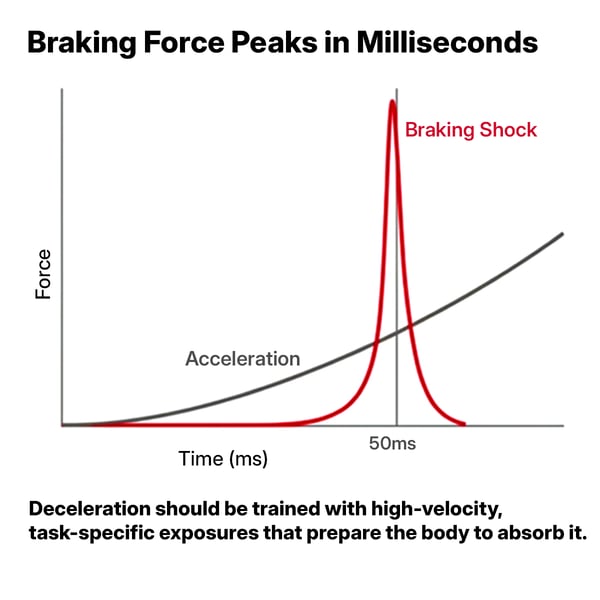 Deceleration and change of direction is the arresting of momentum before cutting, turning, or stopping. It is the most underappreciated demand in multi-directional sport, and arguably the most consequential for both performance and injury. The numbers make the point plainly. Professional soccer players perform 80–104% more high-intensity decelerations than equivalently intense accelerations during match play [32]. Maximum horizontal deceleration can produce substantially greater peak ground reaction forces and loading rates than the initial steps of maximal acceleration, particularly when high approach velocities must be reduced over short distances. These loading peaks occur very early in stance during demanding braking actions [32].
Then there are the qualities that sit alongside braking. Rotational power drives kicking, slap shots, tackling, and throwing, with peak forces in the wind-up and follow-through. Repeated high-intensity efforts define the match itself: an elite soccer player performs 150 to 250 high-intensity actions per match with incomplete recovery, and maintaining velocity across that demand is often the limiting factor. And unilateral force production underpins all of it, because sprinting, cutting, and kicking are single-leg dominant. A 10–15% interlimb difference is a common entry point for a closer look, and the more informative signal is how that difference tracks against the athlete's own baseline [3]. Identifying and addressing asymmetry requires equipment that tests and trains each limb independently, and captures the data to track it over time.
Why the quadriceps are the braking muscle
If rapid braking is the demand, eccentric knee-extension capacity is one of the primary physical contributors, alongside the hip, ankle, trunk, and technical qualities that influence braking performance. Large associations exist between rapid (0–100 ms) eccentric quadriceps torque and horizontal braking force, power, and impulse [32, 33]. Players with greater eccentric quadriceps capacity tend to demonstrate superior horizontal braking performance, likely because greater knee-extensor capacity contributes to producing and tolerating the braking demands required before changing direction [32]. And the association is specific. Eccentric quadriceps strength shows a stronger relationship with horizontal deceleration performance than eccentric hamstring strength does [32, 33].
That has a direct consequence for how you load the quad. The leg press and squat train it, but they are multi-joint movements where the glutes, hamstrings, and other muscles contribute to the output. If the quadriceps are the weak link, the surrounding musculature can compensate and mask the deficit. The athlete completes the rep, the compound numbers look acceptable, and the quad stays undertrained.
A constrained, single-joint movement removes that possibility. It emphasizes quadriceps loading by reducing opportunities for surrounding musculature to compensate, and it gives you a clean window to assess whether they are keeping up with the rest of the chain. The same logic runs through the whole lower body: isolate the tissue when you need certainty that it is being trained, and use compound movements to build the coordination and total output that sport actually requires. The two are complementary, not competing.
The injury case: groin, ACL, and Achilles
Deceleration is not only a performance quality. It is a risk factor, and a modifiable one. Between 32 and 66% of non-contact ACL injuries in soccer occur during a defensive pressing scenario, when whole-body deceleration from high velocity precedes a directional change [35]. Deceleration-related mechanisms are also implicated in calf, hamstring, and rectus femoris injuries [35]. Assessing and developing braking capacity represents one potentially modifiable component within a broader injury-risk reduction strategy.
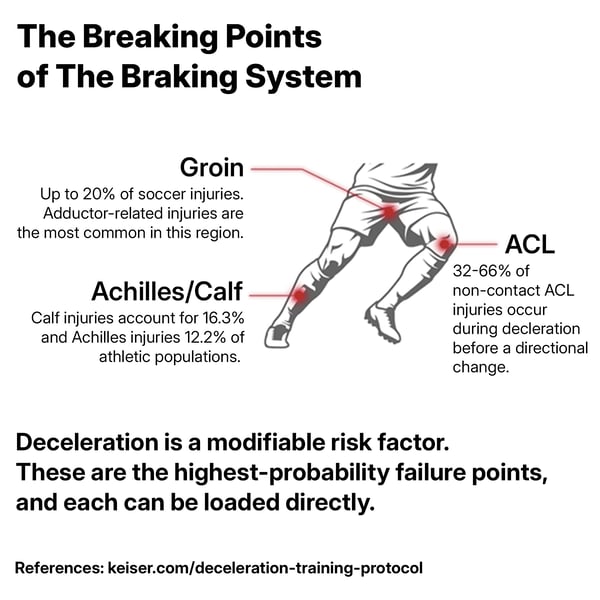
Three sites carry the most consequence, and each can be loaded directly.
Groin. Groin injuries make up as much as 20% of all injuries in soccer, and adductor-related injuries are the most common within that region [9]. Decreased hip-adduction strength is a documented risk factor [9, 10]. The encouraging part is that it responds to training: in a randomized trial with sub-elite players, eight weeks of hip-adduction strengthening significantly increased maximal eccentric adduction strength versus a control group, with direct implications for groin injury prevention [9].
ACL. The 32–66% figure above puts the knee squarely in the deceleration conversation. Because eccentric quadriceps strength is so tightly linked to braking, targeted quadriceps loading may contribute to improving one of the important physical qualities associated with braking performance.
Achilles and soleus. Achilles tendon injuries are among the most common tendon injuries in soccer. Calf injuries account for 16.3% and Achilles injuries 12.2% of injuries in athletic populations [14], and the consequences of an Achilles rupture in a professional career are severe and often career-altering. The soleus is the primary force producer at ground contact in sprinting, and it is also the tissue most easily left undertrained, for reasons we will get to below.
None of this is about promising to eliminate injury. It is about identifying commonly stressed tissues, developing their capacity, and monitoring changes over time.
Why low-inertia resistance for multi-directional sport
Every resistance modality has physics-based advantages and limitations. If the goal is to train braking and high-velocity qualities safely, the mechanics of the resistance itself start to matter.
Keiser's Pure Resistance Technology minimizes mass, inertia, and momentum in the resistance mechanism. Where conventional equipment requires the athlete to accelerate and then decelerate system mass on every rep, the Keiser A400 platform uses compressed air under digital control, a resistance source with almost no mass. A few practical consequences follow from that.
There is minimal inertia at the start of the rep, so no extra force is needed just to get the resistance mechanism moving. The resistance the athlete feels is the resistance you prescribed. Resistance stays constant across the full range of motion, reductions in effective external loading where load effectively drops mid-rep, which is especially useful at submaximal, high-velocity loads. Reduced external inertia may allow athletes to maintain movement intent through a greater portion of the concentric phase: on average, mean and peak pneumatic velocity run 36.5% and 28.3% higher than free weight at equivalent loads [4]. Reduced external moving mass may permit smoother changes in externally applied force during some exercise conditions, which matters when you are training athletes through congested schedules where tendon and ligament stress is already elevated.
The result is a modality that works across the full training spectrum: strength at slow tempos, power at moderate tempos, and speed at high tempos. Pneumatic resistance offers a complementary option to traditional iron training by reducing external inertia while allowing athletes to maintain movement intent across the range of motion.
Velocity on every rep
Velocity-based training is not new. What is usually missing is coverage. Traditional VBT is constrained to a handful of rack exercises with an external device clipped to the barbell. Isolation work, the exact places where a hidden deficit tends to hide, goes unmeasured.
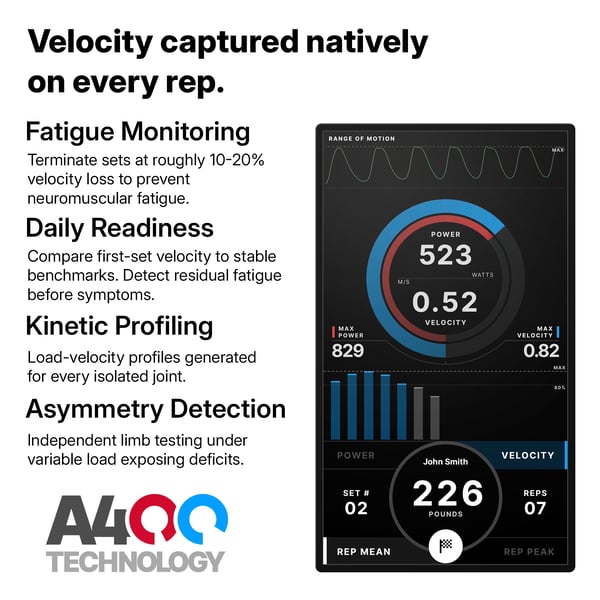
On the A400, every machine in the suite captures mean velocity, peak velocity, power, and range of motion on every rep. That changes what you can do with the data in four concrete ways.
1. Fatigue Monitoring
You can terminate a set when velocity drops below a prescribed threshold rather than chasing an arbitrary rep count. Research in professional soccer players confirms that limiting velocity loss to 15% versus 30% produced superior sprint and change-of-direction improvements with less fatigue accumulation [8]. The machine enforces the threshold you set.
2. Daily Readiness
Compare an athlete's first-set velocity at a standardized load to their recent stable benchmark. A meaningful drop signals residual fatigue before the athlete reports it, and without requiring a maximal effort to detect it.
3. Load-Velocity Profiling Across the Kinetic Chain
Not just squats. Leg press, leg curl, leg extension, hip, and calf each generate their own profile. An athlete can post normal compound numbers on the leg press while carrying a developing quadriceps deficit that only shows up on isolated leg extension testing, or a soleus weakness masked by gastrocnemius compensation that only the seated calf exposes. A full profile, light load to near-max, takes about three minutes on any machine once a baseline exists.
4. Unilateral Asymmetry Detection
Every machine tests limbs independently under variable load. Two limbs can look symmetrical at heavy loads and still show a meaningful velocity gap at light, high-speed loads, a divergence that any assessment testing only near-maximal force will miss. A developing asymmetry may be an early warning, not a diagnosis, worth catching at week three rather than after a symptom.
The lower-body suite, machine-by-machine
A complete lower-body platform is built around seven machines that cover the full kinetic chain, and each one earns its place by doing something the others cannot. The compound stations, the leg press and squat, build coordination and total force output. The isolation stations target a specific tissue to be trained and measured directly, rather than masked by the muscles around it. Cross-machine testing can identify machine- and task-specific strength, velocity, and interlimb patterns that may guide further assessment. These data should be integrated with field braking tests, technical analysis, symptoms, exposure history, and clinical findings to provide the best possible prescription.
The 4-Way Hip: four functions no other machine covers
The 4-Way Hip performs four distinct functions, and none of them are replicated elsewhere in the suite.
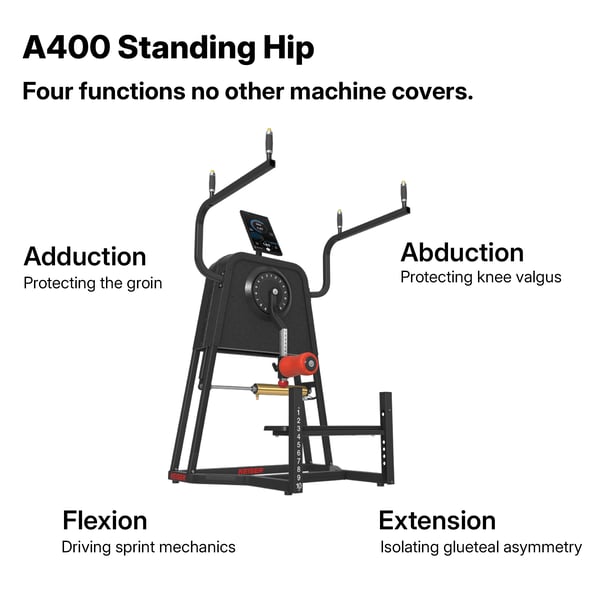
1. Adduction
Adduction is the primary exercise for reducing groin injury risk, and here the value is the data. A constrained, repeatable setup gives you velocity and load on every rep, which means you can track left versus right adduction velocity at matched loads across the season and flag a developing asymmetry before symptoms appear. Isometric holds allow Copenhagen-style loading at precise, progressive intensities.
2. Abduction
Abduction protects the ankle and the knee. Diminished hip-abductor performance is associated with lateral ankle sprain [26], and hip-abductor weakness may predispose athletes to the frontal-plane knee collapse (valgus) that is a primary mechanism in non-contact ACL injury [27]. Isolated abduction on Keiser's 4-way Hip offers another great way to improve hip-abductor capacity, which may contribute to the lower extremity control needed to prevent valgus. Hip-abductor capacity may contribute to frontal-plane control, but it is important to note that isolated strength should be combined with task-specific landing, cutting, and braking training.
3. Hip Flexion
Hip flexion is loaded here from a lengthened position, with the hip starting in extension. That matters because the hip flexors are primary movers in the late swing phase of sprinting and the wind-up of kicking [11], and training at longer muscle lengths may produce possibly an increased hypertrophic benefit over short-lengths[29]. No other machine in the suite loads hip flexion in the range that matters most for kicking and sprint mechanics.
4. Hip Extension
Hip extension gives you a window into gluteal function. Assessing hip extension independently on each limb flags a side-to-side difference that compound movements cannot isolate.
The Seated Calf: the Achilles and sprint-contact machine
The seated calf is the cleanest single-machine example of assess, intervene, and monitor working together, and it solves a problem that standing work quietly hides.
A standing calf raise trains the soleus, but only if the soleus is already functioning normally. The soleus can be inhibited after ankle sprains, disuse, or tendinopathy, and in a standing position, with the knee extended, the gastrocnemius is mechanically advantaged to take over. If the soleus is inhibited, the gastrocnemius picks up the slack, the deficit goes undetected, and the numbers look fine while the soleus stays underloaded.
The seated position, knee flexed to roughly 90 degrees, changes the mechanics. Knee flexion shortens the gastrocnemius across both joints, reducing its activation and torque, so the soleus has to do the work [17, 18]. This is not a subtle bias. The seated position allows you to target the soleus and its subtendon, which matters because the soleus is the primary force producer at ground contact and the plantarflexors are responsible for 49–62% of the vertical ground reaction force during running [12, 13].

Because the machine operates each limb independently, it becomes three tools in one. You can assess with a load-velocity profile on each leg, comparing left versus right at each load point and re-testing differences in the 10–15% range to see if they persist. You can rehabilitate with controlled, progressive loading and real-time velocity, dosing isometric holds, heavy slow resistance, and dynamic work on one machine. And you can monitor velocity at a standardized load across the season, where a developing asymmetry is an early warning of soleus fatigue, Achilles irritability, or residual deficit from a prior injury, before the athlete reports a symptom.
The rest of the chain
The leg press covers overall lower-body force capacity. The leg extension isolates the quadriceps, the braking muscle discussed above. The leg curl emphasizes hamstring loading that compound pulls cannot ensure. The squat builds movement-pattern competency and loads the gastrocnemius through the calf raise. The functional trainer handles multi-planar, anti-rotation, and accessory work. Together the seven machines form a single assessment battery: a developing issue at the hip or ankle often shows up as pain somewhere else, at the knee, the lower back, or the opposite limb, and cross-machine profiling catches the upstream cause rather than the downstream symptom.
The AIM loop: assess, intervene, monitor
All of this runs on one loop. Assess, Intervene, Monitor. And the reason it works is that every machine closes that loop on the same rep.
Most setups treat assessment, training, and monitoring as three separate jobs that need three separate tools: a force plate to test, a rack to train, a transducer to monitor. The A400 collapses all three into one machine. Every rep an athlete trains is a rep you can measure, which means the data that drives the program is the same data that flags fatigue and catches a developing asymmetry.
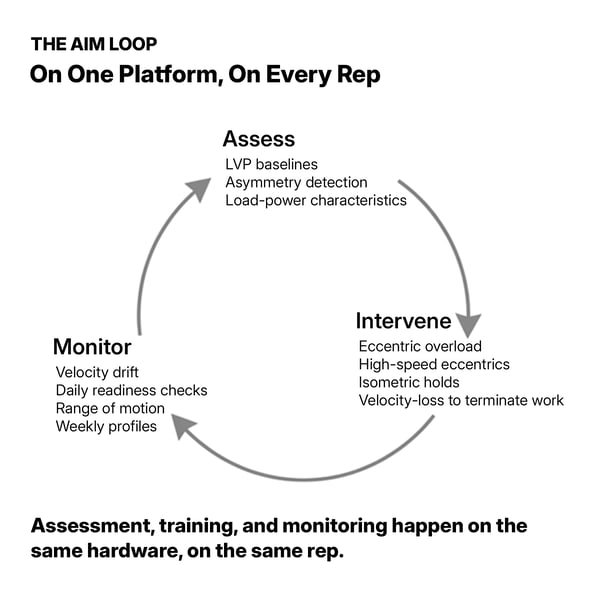
Assess. The demands model tells you what to measure. Load-velocity profiles across the kinetic chain establish each athlete's baseline, and independent limb testing exposes the asymmetries that heavy-load testing hides.
Intervene. The profile turns into programming. Eccentric overload, isometric loading, and high-speed eccentric work build the braking capacity that the weight room typically neglects.
Monitor. Velocity drift, range of motion, and weekly profiles track the response, session to session and week to week. A developing asymmetry surfaces at week three, not after the strain.
Then you reassess, and the loop turns again. That is the part no competitor can match, because no other platform measures ROM, velocity, power, performance drop-offs (and more) on every machine. It is also why the platform compounds in value over time: the longer an athlete trains on it, the deeper the profile, and the earlier the next problem shows up.
Get the full protocol
Everything above is the reasoning. The full Deceleration Training Protocol provides the operational build.
It was written by practitioners for practitioners, backed by 35 peer-reviewed references, and developed for a professional (MLS) club's A400 suite so that it can be replicated in any elite environment. The download adds the following to what was presented here:
-
The complete training prescription table: eight training qualities mapped to specific machines, with sets, reps, loads as a percentage of KOPR and 1RM, velocity-loss thresholds, and rest periods. Programming you can implement on day one.
-
The full machine-by-machine equipment rationale with all supporting research.
-
The data integration and monitoring playbooks.
-
A multi-facility deployment framework for programs training across two sites.
-
A sample staff education plan for onboarding coaching staff to the platform.

GET THE DECELERATION TRAINING PROTOCOL
Developed for a professional MLS club's A400 suite and built to replicate in your program. 35 references included.
Download Now
Frequently Asked Questions
About the Author
Landon Evans, Vice President of Human Performance, Education, and Research
In his role at Keiser, Landon oversees the development and implementation of evidence-based training and educational programs that support their worldwide markets. His extensive background in sports science is further demonstrated through his co-founding of Malum Terminus Technologies, an AI-based risk-mitigation platform developed from U.S. Department of Defense-funded research at the University of Iowa Technology Institute’s Virtual Soldier Research Program. Before Keiser, Landon served as the Director of Sport Science, Assistant Strength and Conditioning coach to Track & Field, and for four years, served as the sports nutrition coordinator at the University of Iowa.
References
Selected peer-reviewed sources cited in this article. The full Deceleration Training Protocol includes all 35 references.