3 min read
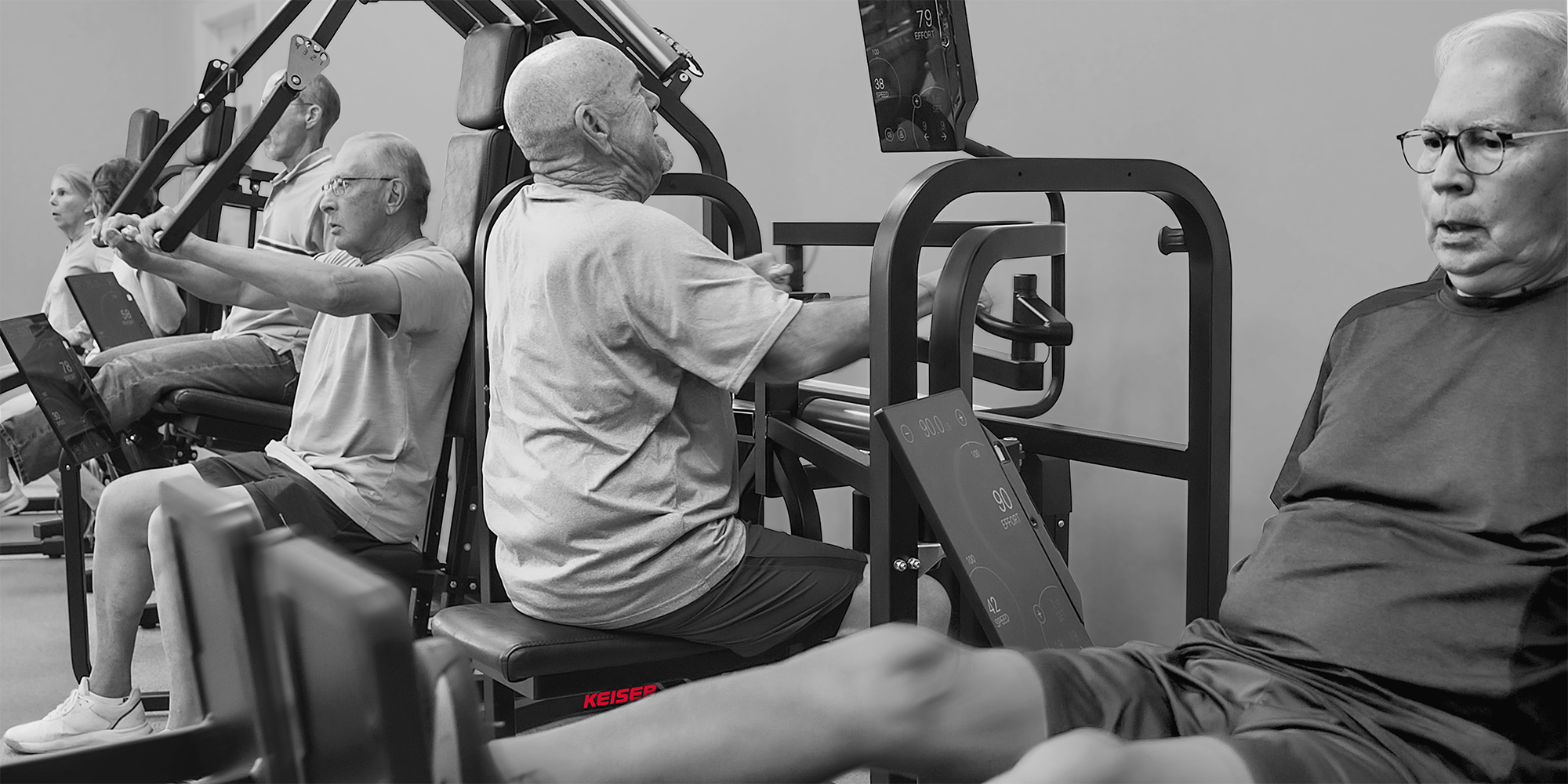
Keiser Launches the Performance Longevity Course for Older-Adult Practitioners

On November 10, 2026, Keiser announced its Performance Longevity framework over PR Newswire. The framework comes with a new course, Performance Longevity: Bridging the Gap Between Healthspan and Lifespan. Keiser built it for wellness directors and their teams, senior living executives, physical therapists, and older-adult fitness practitioners. Read the full release on PR Newswire.
The course gives practitioners a method to assess physical capacity, find the quality that limits a person, and then prescribe and progress exercise for that person.
Muscle power declines faster than strength
With age, muscle power declines faster than maximal strength. Power is force times speed. So a client can keep enough strength to lift a load and still lose the speed to use it when it counts, such as stepping up a curb before the light changes or catching a stumble.
Exercise programs for older adults may not cover the full range of physical qualities that independence needs. Light, slow, repeated movement builds some capacity. It can leave speed and reserve untrained.
The release names three patterns that hold outcomes back: under-dosed programs, too little progression, and functional results that stall. The course answers them with three principles from strength and conditioning: individuality, specificity, and progressive overload. A program that avoids challenge is not safer by default. Older adults need exercise that is hard enough to cause adaptation.
Performancespan counts the years of usable capacity
Lifespan counts years alive. Healthspan counts years in good health. Performancespan counts the years a person keeps the physical capacity to do what they need and want to do.
Residents and clients live inside that third number. It decides whether a person can carry laundry up the stairs, get up from a low couch, or walk to the dining room at a normal pace.
Four concepts shape the course
Training for Adaptation. Strength, power, speed, and endurance each add to daily function in a different way. Each one also responds to a different dose. The course shows how to set intensity, movement speed, progression, and recovery to build the qualities that matter most for independence. In general, a power goal calls for fast intent against a moderate load. A strength goal calls for heavier loads.
Capacity vs. Task Demand. Every task has a physical cost. A flight of stairs asks for a certain amount of leg strength and power. When the demand of a task is higher than a person's capacity, the person struggles, slows down, or stops doing the task. Training closes the gap from the capacity side, and that gain carries over to many tasks at once.
A More Complete Definition of Independence. One good sit-to-stand on a good day shows capability. Independence also needs consistency, which means the person can do the task again and again. It needs reserve too: the margin left over when demands change. A person draws on reserve during an illness, on an icy sidewalk, or at the end of a long day.
Keiser AIM: Assessment, Intervention, Monitoring. AIM works as a loop. First, choose assessments that relate to function and read the results with care. Use them to find the physical quality that limits the person. Prescribe exercise that targets that quality. Then monitor how the person adapts, and use that data to make the next programming decision.
Four assessments show where capacity stands
The course recommends four types of performance assessment. It also teaches how to select each test and apply it to the right person.
- Gait speed gives a fast, low-cost view of overall function. It is simple to repeat, so you can track change over months.
- Sit-to-stand tests a task people do many times a day. Timed or repeated versions show lower-body strength, power, and endurance in one familiar movement.
- Balance tests show how well a person controls the body over the base of support. The results help direct fall reduction work.
- Upper and lower body muscle power shows how fast a person can produce force. Keiser's Pure Resistance Technology™ lets practitioners measure power and see if force production or movement velocity limits performance. That answer points the program toward more load or more speed.
The launch marks 25 years of ICAA support
The course debut marks 25 years of continuous Keiser support for the International Council on Active Aging (ICAA). Keiser shared concepts from the course at the 2026 ICAA Conference, held November 17-19 in Orlando.
Crystal Johnson, STEP Director & Older Adult Market Lead at Keiser, described the goal for the next 25 years:
The active aging industry is becoming more and more aware of the gap between healthspan and lifespan. The next 25 years must be about measuring outcomes and extending performancespan, not just lifespan.
We know that aging affects strength, power, speed, and our ability to respond to physical demands. We also know that these qualities remain responsive to exercise across the lifespan. What matters is translating that science into practice: recognizing early changes in physical capacity, identifying what needs to be trained, and making informed decisions about how to progress. That's the foundation of performance longevity.
CRYSTAL JOHNSON
STEP Director & Older Adult Market Lead at Keiser
Start the Performance Longevity course
The course is now open, learn more here. The price is $149.99. Through December 31, 2026, use code ICAA25YEARS to take the course free.
To share the framework with your team, download the Performance Longevity brochure.