7 min read

A large prospective study published in Mayo Clinic Proceedings in August 2025 followed nearly 3,900 men and women aged 46 to 75 for over a decade.¹
The finding was striking:
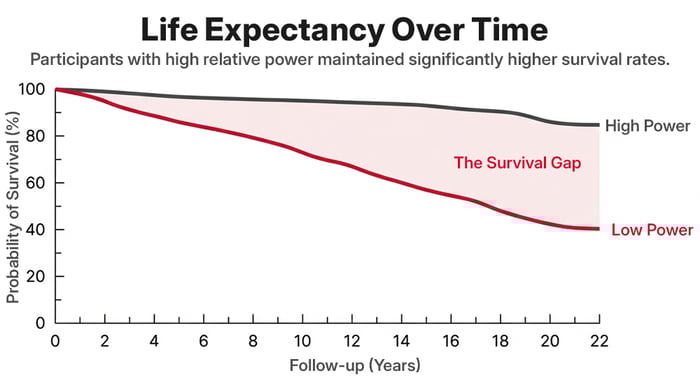
Muscle power — the ability to move a load with speed — predicted mortality far more accurately than muscle strength alone.
The difference was not marginal.
Men in the lowest category of relative muscle power had a 5.88 times higher risk of death compared to those in the highest category. For women, that number was 6.90 times.
When the researchers ran the same analysis for relative muscle strength (measured by handgrip), the hazard ratios dropped to 1.62 and 1.71, respectively. Neither reached statistical significance after adjusting for age, body composition, and medical history.
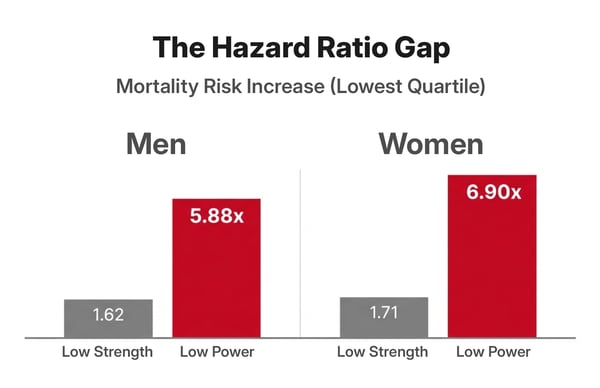
Note: Female estimates reflect fewer observed deaths in the cohort, which increases uncertainty in the precise magnitude of effect. The direction of the association remains consistent.
This study, led by Dr. Claudio Gil Araújo and colleagues from the CLINIMEX Exercise cohort in Brazil, is the first to directly compare upper-body muscle power and strength as predictors of mortality in the same participants, using the same visit data.
An accompanying editorial by Drs. Salvatore Carbone and Windy Alonso put it plainly:
Clinicians and coaches should move beyond asking ‘How much can you lift?’ and start asking ‘How fast can you lift it?’ ²
What the Researchers Measured
The study assessed muscle power using an upper row movement on a FitroDyne device, which calculates mean power (force × velocity) during the concentric phase of the lift.
Participants increased load incrementally and performed each repetition as fast as possible until the product of force and velocity peaked and then declined. That peak value, divided by body weight, became their relative muscle power (rPOW) score.
Muscle strength was measured with a standard handgrip dynamometer, the most common clinical strength test worldwide. The best of four attempts, divided by body weight, became relative muscle strength (rSTR).
Both metrics used the same body-weight adjustment. Both tested the upper body. The study design isolated one central question:
Does the speed component of muscle function carry prognostic information beyond force alone?
The answer was clear.
Across every statistical test the researchers applied — including Cox regression, C-index improvement, net reclassification, and integrated discrimination — power outperformed strength in predicting who survived and who did not.
The Speed Component of Muscle Function
Strength measures how much force your muscles can produce. Power measures how quickly you can produce that force.
The formula is simple:
-
Power = Force × Velocity
That velocity component maps directly onto the movements that keep people independent and resilient:
-
Catching yourself mid-stumble.
-
Pushing up from a low chair.
-
Climbing a flight of stairs without pausing.
-
Bracing during a sudden stop.
Each of these demands rapid force production — and rapid force production is what declines earliest with age.
Research has shown that muscle power begins to deteriorate before strength does, and at a steeper rate. A 2022 study in JAMA Network Open (Balachandran et al.) synthesized data from randomized controlled trials with 566 older adults and found that power training delivered greater functional benefits than traditional strength training.³
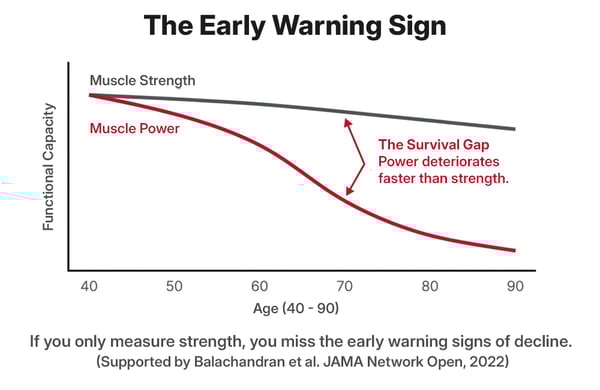
The Araújo study now adds a mortality dimension to that functional finding.
The editorial framed this decline in practical terms² : many daily activities demand speed under load, and a metric that captures power may serve as a more sensitive, earlier indicator of functional reserve. When that reserve runs low, the risk of falls, fractures, loss of independence, and reduced physical activity rises with it.
Power vs. Strength: A Clear Separation
The contrast in predictive value was substantial.
The magnitude difference was not subtle. It was directional, consistent, and statistically robust.
One methodological note: the power and strength tests were not matched modalities. Power was assessed dynamically via an incrementally loaded upper body row, while strength was assessed via handgrip dynamometry -- a convenient clinical proxy, but not a maximal upper-body strength test. Part of power's predictive edge in this study may reflect the higher fidelity of the power assessment itself.
Implications for Sarcopenia and Clinical Assessment
The Global Leadership Initiative in Sarcopenia (GLIS) recently excluded muscle power from its diagnostic criteria, citing insufficient consensus among specialists.
The Araújo study directly challenges that decision.
If power predicts mortality more strongly than strength — and this study's data is compelling on that point — then a definition of sarcopenia built around strength and muscle mass alone may miss the most prognostically relevant dimension of age-related muscle decline.
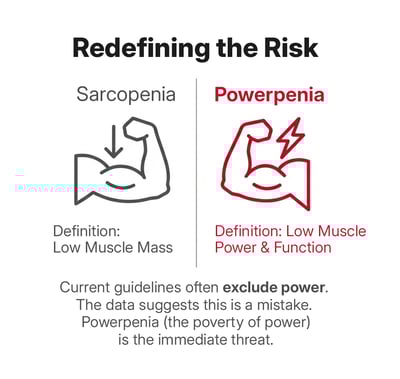 As the editorial noted, this could lead to misclassification of at-risk individuals and training programs that fail to address the specific functional deficits tied to survival.
For physical therapists, rehab directors, and clinicians working with aging populations, this research makes a case for incorporating dynamic power assessment into routine evaluations.
Handgrip testing is convenient and inexpensive, and it retains value as a screening tool. Power assessment adds a layer of information that, according to this data, substantially improves risk prediction.
What This Means for Training Programs
The Core Takeaway
The study's training implications are direct. The editorial concluded that "the modality of resistance training, specifically power training, may better promote longevity" and advocated for "a greater emphasis on power-oriented training in exercise prescriptions."
Power training — which shares principles with velocity-based training — programs the concentric phase of each rep to be performed as fast as possible at moderate to heavy loads. This approach has gained traction across clinical, athletic, and tactical populations, and the Araújo study gives it a stronger evidence base.
For Strength & Conditioning Coaches
The data reinforces what many already program: speed matters under load. The relationship between power and athletic performance is well established. This study extends that relationship to long-term health outcomes.
For Senior Living & Wellness Facilities
For wellness directors and fitness managers in older adult and retirement communities, the message is equally actionable. Power training is safe and effective for older adults when the equipment allows it. The case for power training in fall reduction and the science behind aging powerfully both align with what Araújo and colleagues found. This new research strengthens the case for making power a centerpiece of programming — and for using assessments that track it over time.
For Tactical Professionals
For tactical professionals in military units, fire departments, and law enforcement, the ability to produce force quickly under load is a daily operational requirement. Climbing stairs in turnout gear, breaching doors, dragging victims, changing direction under load — these are expressions of power, not just strength.
Power training has long been a fixture in these environments because it improves operational performance and injury resilience. As discussed in our analysis of firefighter training and job readiness and in our review of military readiness and force production, speed under load is foundational to real-world performance.
The Araújo data now extends that relevance beyond mission execution. It connects rapid force production to long-term survival across the lifespan. This reinforces the idea that training for power is not only job-critical, but life-critical.
The Equipment Question
Why Traditional Equipment Has Limits
Training for power requires equipment that allows high-velocity movement under meaningful resistance. Traditional weight stacks and plate-loaded machines carry mass, inertia, and momentum. The faster you move them, the more momentum builds and the more you have to decelerate at the end of the range of motion. That deceleration phase limits how fast you can safely train and how much of the rep you spend producing force at peak velocity.
How Keiser's Approach Is Different
Keiser's resistance machines use a low-inertia architecture with compressed air under digital control (pneumatic resistance). The resistance has almost no mass. Move it fast, and there is no momentum to throw or absorb. This makes it possible to train the concentric phase at true maximal velocity across a full range of motion — at any load, for any population, from a 78-year-old in a rehab setting to a Division I athlete in a weight room.
Built for This Exact Variable
The study measured power as the peak product of force and velocity across incrementally increasing loads — the exact training variable Keiser's Pure Resistance Technology was engineered to optimize. Dennis Keiser built this company around the idea that training should reflect how the body actually performs: moving with speed and precision under resistance. The Araújo study shows that this principle applies well beyond sport.
What Comes Next
The researchers identified two open questions for future work.
-
First, whether muscle power's prognostic value holds after adjusting for cardiorespiratory fitness and physical activity levels — both strong, established predictors of mortality that this study did not measure.
-
Second, whether power training itself reduces mortality compared to conventional resistance training. That question will require randomized controlled trials.
The editorial also noted a practical gap: the field currently lacks a widely available, clinically standardized measure of muscle power. Handgrip dynamometers are everywhere. Power testing devices are less common.
That does not mean power cannot be measured. Commercially available systems already capture force and velocity data in real time (see Keiser A400), allowing practitioners to assess peak power across incremental loads. What the field lacks is broad clinical standardization and consensus around testing protocols.
As research continues to clarify power’s prognostic value, expect assessment tools that measure force × velocity to move closer to routine clinical adoption.
For now, the evidence points in a consistent direction:
-
Power declines faster than strength with age.
-
Power predicts mortality more strongly than strength.
-
Power training appears to produce greater functional benefits than traditional strength training.
Facilities and practitioners who build their programs around these findings are positioning their members, patients, athletes, and operators for better outcomes.
The question worth asking of your program, your assessments, and your equipment is straightforward:
Are you training for speed?
Related Reading
- Why Power Training Matters for Fall Reduction
- Science-Backed Secrets to Age Powerfully
- The Power of Speed: Why Everyone Needs It in Your Fitness Routine
- A Guide to Power Training for All Levels
- Keiser Resistance Technology: Train Strength, Speed, and Power
About the Author
 Mike Hazle, VP of Marketing at Keiser, is a former Olympian and U.S. special operations soldier. With a background as a professional athlete and U.S. special operator, he brings experience in human performance and intimate knowledge of the Keiser brand to his role. Hazle was a multisport athlete at Texas State University before focusing on javelin throwing, ultimately qualifying for the Beijing Olympics in 2008. After his athletic career, he served in the U.S. Air Force as a Special Operations Command Combat Controller. Hazle holds a bachelor's degree in exercise science and a master's degree in sports management from Texas State University. Keiser equipment was a mainstay in his high-intensity conditioning and is now used by him for recovery.
References
1. Araújo CGS, Kunutsor SK, Eijsvogels TMH, et al. Muscle power versus strength as a predictor of mortality in middle-aged and older men and women. Mayo Clin Proc. 2025;100(8):1319-1331. DOI:10.1016/j.mayocp.2025.02.015
2. Carbone S, Alonso WW. The need for speed: improving muscle power for longevity [editorial]. Mayo Clin Proc. 2025;100(8):1281-1284.
3. Balachandran AT, Steele J, Angielczyk D, et al. Comparison of power training vs traditional strength training on physical function in older adults: a systematic review and meta-analysis. JAMA Netw Open. 2022;5(5):e2211623.
Subscribe to Keiser's FREE publications
Receive tips, articles, and tools to improve human performance via email.