8 min read
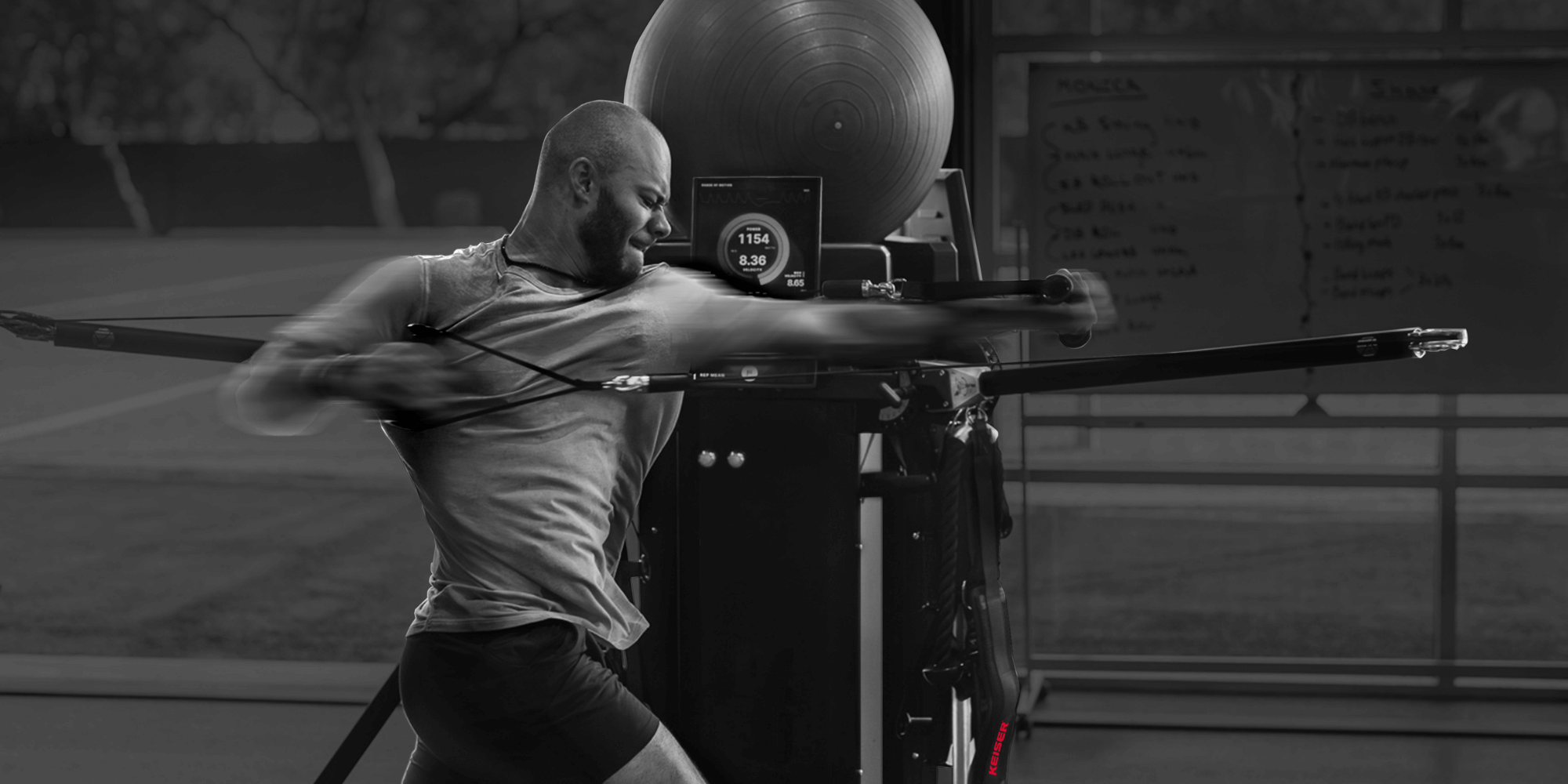

Rotational power is the primary driver of performance in nearly every dynamic sport, from the golf course to the pitcher's mound. It is the ability to generate and control force through the transverse plane. Modern athletic research emphasizes that training the body to transfer rotational power effectively requires an integrated, movement-based approach rather than isolated exercises. By focusing on the way the body moves in three planes, rotational athletes can learn to channel the force generated by the legs through a stiff, stable core and into the arms, maximizing speed and efficiency1.
While traditional strength training (e.g. squats, deadlifts) provides the raw materials for force and stability, rotational training provides the architecture that allows those qualities to be expressed at speed. This is what ultimately translates training in the gym to performance on the field of play.
The Biomechanics of Rotation
Core Principles
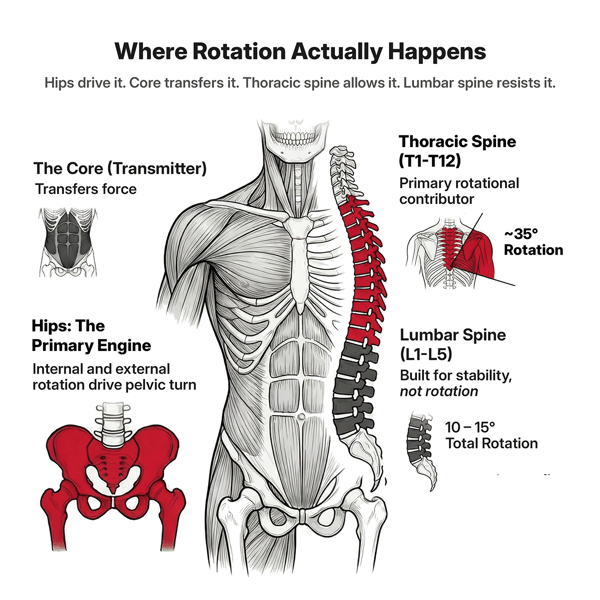
To train rotation effectively, we must understand that “turning” is a full-body event.
Traditional “ab exercises” like crunches are often overrated for rotational athletes. Electromyography (EMG) studies show that standing rotational movements — such as cable chops — activate the internal and external obliques far more than floor-based exercises3.
Stability is also most effective when it is functional. The goal isn’t simply holding a plank, but maintaining stability while standing and moving13.
When training is performed in a standing, integrated position:
-
The lead-leg glutes stabilize the pelvis
-
The core resists unwanted rotation
-
The body is prepared to transfer force explosively13.
The Joint-by-Joint model reinforces this approach. It emphasizes:
-
anti-rotation drills
-
single-leg strength
-
core stability under movement
Together, these qualities build a core capable of handling high-velocity rotational torque without injury1.
The core functions as proximal stability — the stable base that allows the rest of the body to generate and transmit power8.
Without this stability, energy leaks and performance suffers.
With it, the system works like a bow:
-
the hips act as the bow
-
the spine becomes the bowstring
When properly loaded, this system allows the body to rotate safely, efficiently, and explosively11.
Understanding these principles helps explain where rotation actually occurs and how power moves through the body.
The X-Factor Stretch
Rotational power hinges on two critical phenomena: the X-Factor Stretch and the Serape Effect.
The X-Factor Stretch refers to the active loading of the torso muscles as the hips initiate rotation while the shoulders are still turning, creating a powerful elastic “pre-stretch”2.
Pelvic-shoulder separation is critical to producing the “whip” effect in throwing and swinging motions. The timing of this separation, combined with core stiffness, allows energy to flow efficiently from the ground up4.
Hip rotational strength and anti-rotation stability are the strongest predictors of rotational speed and clubhead or arm velocity9.
The Serape Effect and Myofascial Continuity
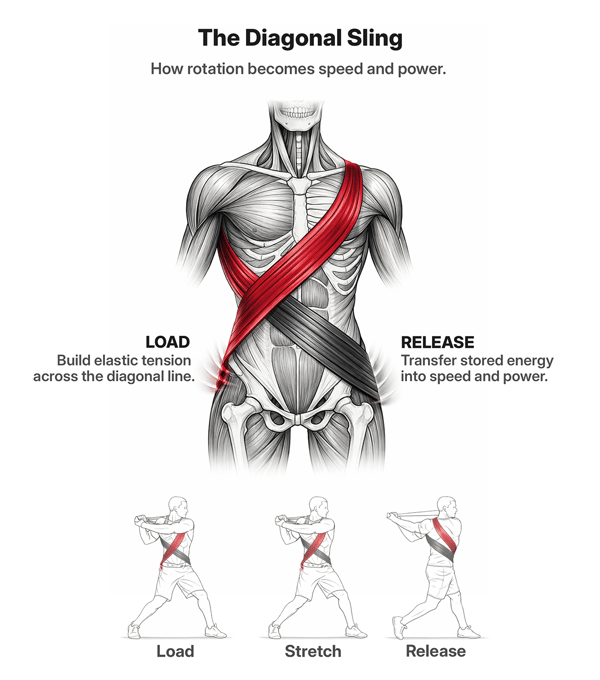
This stretch engages the Serape Effect, named after a Mexican shawl that wraps from one shoulder across the chest to the opposite hip. It describes a diagonal pattern of muscles and fascia functioning like a tightly wound elastic band, storing energy that can be explosively released2,14.
The Spiral Line, a continuous fascial connection from shoulder to opposite hip, physically underpins the Serape Effect and enhances energy transfer beyond muscle contraction alone12.
Instead of thinking about these muscles as separate parts that work alone, sports scientists increasingly view them as one connected sling system. When an athlete “loads” into rotation, this system tightens like a spring across the torso.
Optimal performance is achieved by accelerating through the motion, often releasing the load to fully express rotational power14.
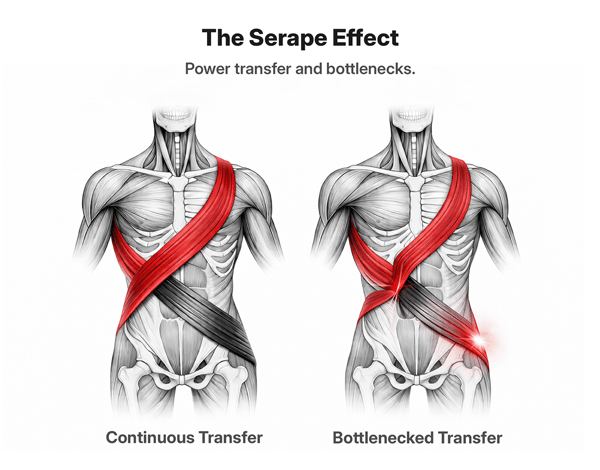
Understanding this fascial "web" is a huge deal for athletes because fascia is much better at snapping back than muscle tissue is. It acts like a "steadying" force that keeps your hips stable and your knees moving correctly during a fast pivot. By viewing the Serape Effect as one big connected web, athletes can understand why a tight spot in the hip can "pull" on the line up to the opposite shoulder. This creates a "bottleneck" where power gets stuck. If your hip is tight, no amount of shoulder exercises will fix your power problem because the whole "rubber band" is held back from the bottom.
This diagonal tension system is often described as a “serape” pattern, where force travels across the body from one shoulder to the opposite hip.
The Pneumatic Revolution: Why Keiser Matters
Pure Resistance Technology
In high-velocity rotational sports, traditional weights have a fatal flaw: Inertia. When you attempt to accelerate a standard weight stack quickly, the initial effort requires a massive burst of force to overcome the "dead weight," but once that weight is in motion, momentum causes it to "float" or travel upward on its own. This means your muscles actually unload and stop working at the end of the range, the exact moment where you should be reaching peak acceleration.
Furthermore, traditional stacks are plagued by mechanical "jerk" — the jarring, non-linear spikes in resistance that occur when the cable goes slack and then snaps taut. This inconsistent tension can disrupt an athlete's "feel" and timing.
The Infinity Series
The Keiser Functional Trainer (FT) and Keiser Performance Trainer (PT) utilize use a low-inertia architecture with compressed air under digital control (pneumatic resistance) to solve these physics-based limitations. By replacing iron plates with Keiser Technology, we provide a "massless" resistance.
Minimizes Mass, Inertia, and Momentum
The resistance remains constant regardless of how fast you move. You can accelerate through the entire range of motion without the resistance "falling away" or floating.
Smoothness and Safety
Keiser technology eliminates the "jerk" associated with moving iron. There is no heavy weight stack banging at the end of a rep, which significantly reduces the jarring impact on the lead hip and shoulder during high-speed deceleration.
Real-Time Feedback
Keiser’s A300 Power Display calculates and informs with Peak Power (Watts) for every repetition. The A400 Technology adds in the accuracy and versatility of power, velocity, and range of motion. This transforms a standard set into a high-stakes performance test, ensuring the athlete is training with the "maximal intent" required for professional and recreational sports alike.
Specifically Focused
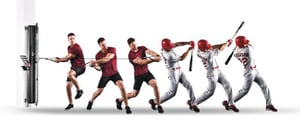 The FT and PT are built to help athletes practice the exact moves they use in their sport. This is called the Principle of Specificity. Replicating sport-specific speed and resistance is essential for rotational training. As mentioned earlier, traditional weight stacks have inertia, causing the load to "float" at high speeds and reducing effective force at the critical moment of acceleration. Keiser's resistance technology eliminates this problem by providing a constant load throughout the motion, enabling athletes to train at speed safer5,7. This allows the core and Serape muscles to engage under sport-specific conditions, reinforcing dynamic correspondence — the principle that exercises must replicate the speed, force-time curve, and plane of the sport17, 19.
The Three Pillars of Training
Core stability is as important as strength. A strong, stiff core acts as a multiplier: if it is weak or “soft,” energy generated by the lower body leaks before reaching the hands, limiting arm or clubhead speed15.
Anti-rotation exercises, such as the Pallof Press, train the core to resist unwanted motion while allowing explosive force transfer6. Reflexive stability — where the nervous system automatically braces during dynamic movements — is best developed through standing, unilateral, and multi-planar exercises10,18.
These methods ensure the core functions as a stiff transmitter, preparing the body for high-speed rotational loads10,18.
A. Anti-Rotation (Stability)
This protects the spine and ensures force is transferred from the legs to the hands without being lost in a "soft" middle.
-
Key Move: The Pallof Press.
B. Rotational Strength (Force)
Moving heavy loads through a controlled arc. This builds the muscular density of the obliques and hips.
-
Key Move: Landmine Rotations or Keiser Lifts.
C. Rotational Power (Force x Velocity) and Speed (Velocity)
The "whip." This involves moving light-to-moderate loads at maximum speeds.
- Key Move: Keiser Chops, Keiser Cable Jump Slam, or Med Ball Rotational Slams.
Sample Workout: Golf Swing Speed
Focus: Maximizing the "X-Factor" (separation between hips and shoulders) and lead-leg stability. Perform each exercise in both directions or split stances.
Sample Workout: Baseball Pitching Power
Focus: Generating linear-to-rotational force and eccentric deceleration for arm health.
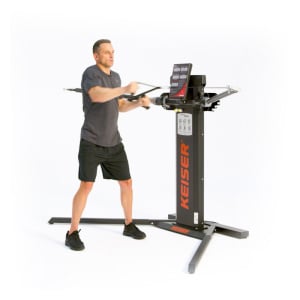
EXERCISE LIBRARY: ENDLESS POSSIBILITIES
Hundreds of movements on one machine. Explore our Keiser Infinity Series video guides.
Watch NowAbout the Author
.jpg?width=100&height=100&name=Thumbnail-Steve-Manz%20(3).jpg) Steve Manz, MS Exercise Physiology, CSCS, XPS, CPT
Steve Manz, MS Exercise Physiology, CSCS, XPS, CPT
Steve is a Human Performance and Education Specialist for Keiser. Prior to joining Keiser, Steve spent 18 years as a collegiate track and field coach, highlighted by numerous NCAA All-Americans (throws and decathlon), a National Champion (discus), and an Olympic Trials Finalist (decathlon). As an athlete, he was a professional shot putter with a best of 66’7”, appearing in 2 Olympic Trials, an Olympic Trial final, and competing internationally in 12 countries. He was a three-time NCAA All-American at Michigan State University and a two-time Michigan High School State Champion (discus '99 and football '97).
References
- Boyle, M. (2016). New functional training for sports (2nd ed.). Human Kinetics.
- Cheetham, P.J., Martin, P.E., Mottram, R.E., & St. Laurent, B.S. (2001). The importance of stretching the "X-Factor" in the downswing of golf: The “X-Factor Stretch”. In P. R. Thomas (Ed.), Optimising performance in golf (pp. 192–199). Australian Golf Institute.
- Escamilla R.F., McTaggart M.S., Fricklas E.J., DeWitt R., Kelleher P., Taylor M.K., Hreljac A., Moorman C.T. (2006). An electromyographic analysis of commercial and common abdominal exercises: implications for rehabilitation and training. J Orthop Sports Phys Ther. Feb; 36(2):45-57. https://doi.org/10.2519/jospt.2006.36.2.45
- Fleisig G.S., Barrentine S.W., Zheng N., Escamilla R.F., Andrews J.R. (1999). Kinematic and kinetic comparison of baseball pitching among various levels of development. J Biomech. Dec;32(12):1371-5. https://doi.org/10.1016/s0021-9290(99)00127-x
- Frost, D.M., Cronin, J.B., & Newton, R.U. (2008). A comparison of the kinematics, kinetics and muscle activity between pneumatic and free weight resistance. European Journal of Applied Physiology, 104(6), 937–956. https://doi.org/10.1007/s00421-008-0821-8
- Hibbs, A.E., Thompson, K.G., French, D. et al. Optimizing Performance by Improving Core Stability and Core Strength. Sports Med 38, 995–1008 (2008). https://doi.org/10.2165/00007256-200838120-00004
- Joyce, D., & Lewindon, D. (2014). High-performance training for sports. Human Kinetics.
- Kibler, W.B., Press, J., & Sciascia, A. (2006). The role of core stability in athletic function. Sports Medicine, 36(3), 189–198. https://doi.org/10.2165/00007256-200636030-00001
- Lehman, G.J. (2006). Resistance training for performance and injury prevention in golf. Journal of the Canadian Chiropractic Association, 50(1), 27–42.
- Liebenson, C. (2014). Functional training of the core. Lippincott Williams & Wilkins.
- McGill, S.M. (2010). Core training: Evidence translating to better performance and injury prevention. Strength and Conditioning Journal, 32(3), 33–46. https://doi.org/10.1519/SSC.0b013e3181df4521
- Myers, T.W. (2001). Anatomy trains: Myofascial meridians for manual and movement therapists. Churchill Livingstone.
- Okada T., Huxel K.C., Nesser T.W. (2011). Relationship between core stability, functional movement, and performance. J Strength Cond Res. Jan;25(1):252-61. https://doi.org/10.1519/JSC.0b013e3181b22b3e
- Santana, J.C. (2003). The Serape Effect: A Kinesiological Model for Core Training. Strength and Conditioning Journal, 25, 73–74.
- Shinkle, J., Nesser, T.W., Demchak, T.J., & McMannus, D.M. (2012). Effect of core strength on the measure of power in the extremities. Journal of Strength and Conditioning Research, 26(2), 373–380. https://doi.org/10.1519/JSC.0b013e31822600e5
- Vanezis, A., & Lees, A. (2005). A biomechanical analysis of good and poor performers of the vertical jump. Sports Biomechanics, 4(2), 197–211. https://doi.org/10.1080/00140130500101262
- Verkhoshansky, Y., & Siff, M.C. (2009). Supertraining (6th ed.). https://verkhoshansky.com
- Willardson JM. (2007). Core stability training: applications to sports conditioning programs. J Strength Cond Res. Aug;21(3):979-85. https://doi.org/10.1519/R-20255.1
- Zatsiorsky, V. M., & Kraemer, W. J. (2006). Science and practice of strength training (2nd ed.). Human Kinetics.
Subscribe to Keiser's FREE publications
Receive tips, articles, and tools to improve human performance via email.